February 7, 2021

Agile VAPT for a better ROI


Agile VAPT for a better ROI

What if I told you that you can increase your secure application release timeline efficiency by 70%? Or in other terms, what if you can release your application 4x in the same timeframe and with assurance that it’s safe from potential vulnerabilities?

Let me take you through the VAPT process which can help you achieve that.

In a traditional process for a security assessment on an application under release, it requires to go through below stages:

  • Penetration Testing: 5 days
  • Report generation: 2 days
  • Remediation of identified issues: 10 days.
  • Re-assessment of remediation process: 2 days
  • Application release: 1 day

Let us look at this traditional approach with timeline perspective:
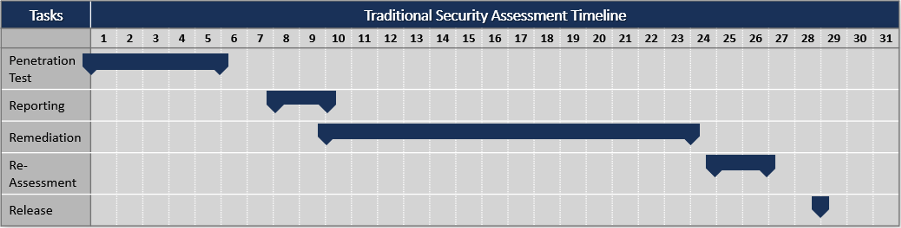
Due to the communication challenges and different supporting activities which helps in the overall process, it usually takes 22 days for an application to get a signoff for release.

Here is a more efficient approach. The Agile security assessment methodology combines the communication channel and asks for collaboration within a single platform. Automating a few manual processes (like submission of issues on the go, creation of reports etc) to reduce the stakeholder responsibilities within the same platform can help in creating a workflow which helps you achieve the above said efficiency.

Now, let’s look at this time efficient alternative:
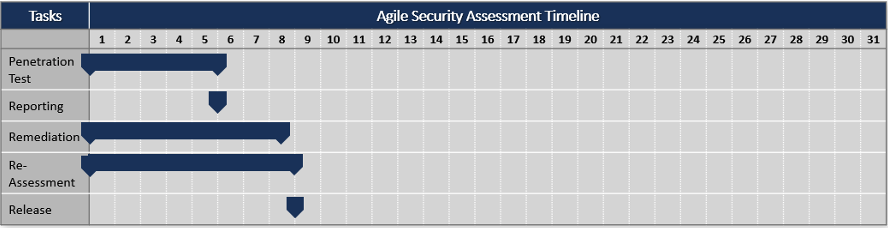
This approach makes use of a platform for continuous integration of the entire process and data consumption to get the vulnerabilities on day 1 which can also be started to fix from the same day. This can bring up the release date timeline for an application to just the 7 Days.

In conclusion, the need of the hour is to have a platform which can bring together the stakeholders for better communication and ease out the entire process to increase productivity along the way.

Author: Bhishm Narula

Recent Resources

Dive into our library of resources for expert insights, guides, and in-depth analysis on maximizing Uni5 Xposure’s capabilities
Enterprise security analysts reviewing a threat exposure dashboard in a modern operations center

Handala: How Enterprise Security Teams Should Respond

Handala can refer to a Palestinian symbol or a cyber threat group. Learn how security teams verify claims and assess exposure.
Read More
Enterprise security team reviewing an attack surface map on a large display

How Should Enterprises Govern Their Attack Surface?

Learn how enterprise attack surface governance connects clear ownership, ongoing discovery, risk-based prioritization, validation, and accountable remediation.
Read More
Two security leaders review a network exposure map on a large screen in a dim operations room

Rapid7 vs Tenable: Questions to Ask First

Compare rapid7 vs tenable on coverage, priority, and closure. Use a same-scope pilot before you choose an exposure approach.
Read More
Security leaders reviewing exposure controls on a wall of monitors in a dim operations room

Qualys Competitors: Controls and Guardrails

Compare qualys competitors with controls, guardrails, and operating questions. Keep exposure evaluations honest and useful.
Read More
Enterprise security team reviewing vulnerability and threat dashboards together

What Does Rapid7 Do? An Enterprise Checklist for Security Teams

Learn what Rapid7 does across cybersecurity, vulnerability management, and security operations, then use this enterprise checklist to assess fit and workflows.
Read More
Enterprise security team reviewing remediation actions and exposure data on a shared display

AI REMEDIATION: How to Measure Coverage, Context, and Action

Learn how enterprise teams can apply AI remediation with clear guardrails, threat context, validation, and measures that show whether exposure truly falls.
Read More

What’s new on Hive Pro?

Get through updates and upcoming events, and more directly in your inbox

Reduce real exposure. Not just vulnerability volume.