Gartner's 5-Step Approach to Continuous Threat Exposure Management

If your security team is drowning in vulnerability alerts but still can't answer the question, "Where are we most likely to get breached?", you're not alone. This disconnect between effort and outcome is exactly why Gartner introduced the Continuous Threat Exposure Management (CTEM) framework in 2022. It's a structured, five-stage cycle designed to help organizations stop chasing every vulnerability and start systematically reducing the exposures that actually put their business at risk.
In this guide, we'll break down exactly what the CTEM framework is, why Gartner created it, the five stages that make it work, and how you can operationalize each one.
Key Takeaways
- The CTEM framework is a Gartner-defined, five-stage cycle, not a product you buy. It provides a structured approach to continuously identify, prioritize, validate, and fix the exposures that matter most to your business.
- Gartner predicts organizations prioritizing CTEM will be three times less likely to suffer a breach, making this framework a strategic imperative for security leaders who need to demonstrate measurable risk reduction.
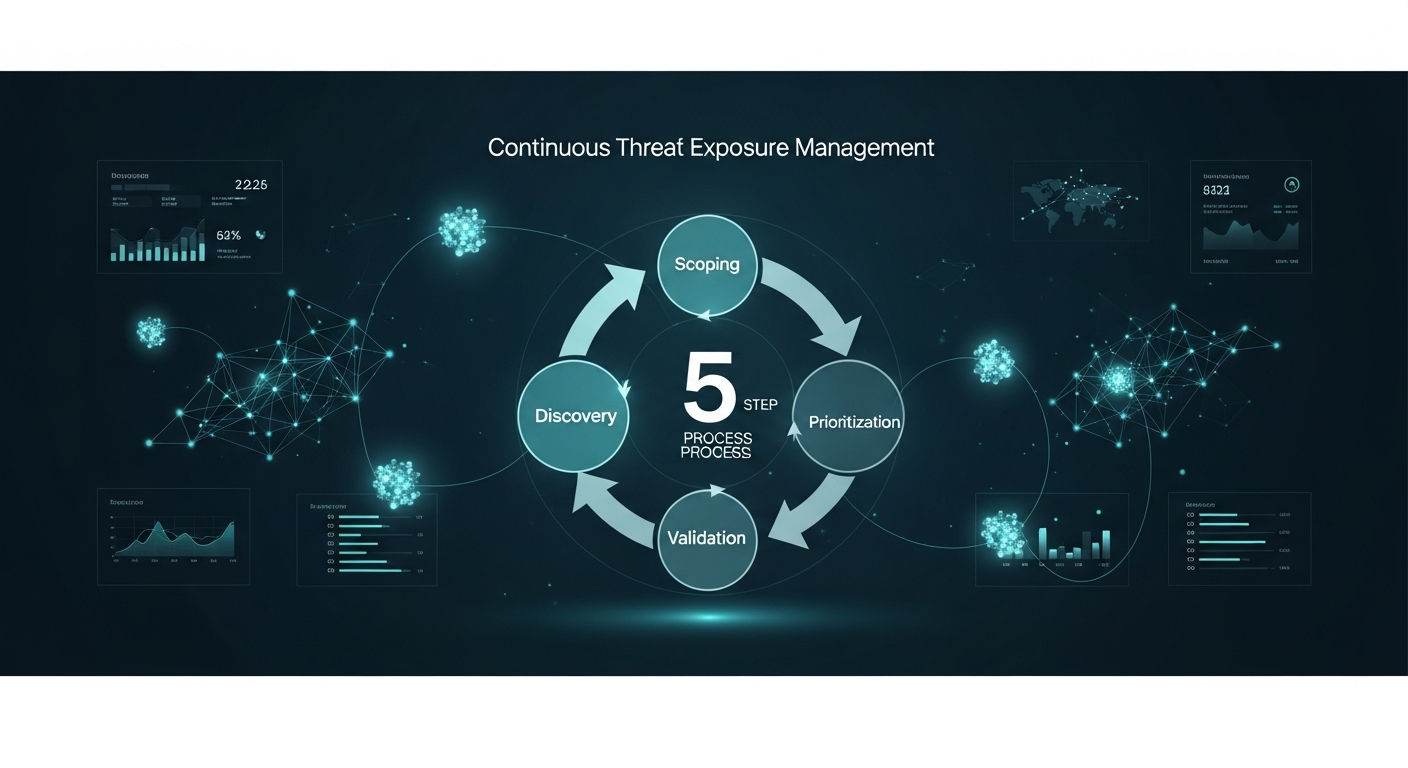
- Each stage builds on the last to create a continuous loop: Scoping defines what matters, Discovery finds the gaps, Prioritization focuses your efforts, Validation proves the risk is real, and Mobilization gets it fixed.
- A unified platform is essential for operationalizing CTEM end-to-end. Stitching together point tools creates silos and blind spots that undermine the continuous nature of the framework.
What Is the CTEM Framework?
The CTEM framework is a strategic cybersecurity program introduced by Gartner to address a fundamental problem: organizations have too many vulnerabilities and not enough context to know which ones will actually get them breached. Instead of periodic scans and static priority lists, CTEM establishes a continuous, repeatable cycle for managing your real-world exposure to threats.
At its core, the CTEM framework operates through five interconnected stages: Scoping, Discovery, Prioritization, Validation, and Mobilization. Together, these stages create a feedback loop that helps security teams align their efforts with business risk, validate that their defenses actually work, and prove that remediation efforts are making the organization safer.
What makes CTEM different from traditional vulnerability management is its emphasis on exposure rather than just vulnerabilities. A vulnerability is a technical flaw. An exposure is that flaw in context: is it on a critical asset, is it reachable from the internet, is it being actively exploited, and would your security controls stop an attacker from leveraging it? CTEM forces you to answer all four of those questions before you commit resources to a fix.
Why Gartner Created the CTEM Framework
Gartner didn't create CTEM in a vacuum. They observed that security teams were spending enormous amounts of time and money on vulnerability management programs that weren't actually reducing risk. The typical cycle of "scan, generate a list, patch what you can, repeat" was producing diminishing returns. Teams were overwhelmed by alert volume, patch backlogs were growing, and breaches kept happening despite compliance with scanning schedules.
The CTEM framework was Gartner's answer to this problem. By introducing a structured process that incorporates business context, threat intelligence, and validation into every cycle, Gartner provided a blueprint for moving security from a reactive, compliance-driven function to a proactive, risk-reduction engine. Their research indicates that organizations that prioritize their security investments based on a CTEM program will be three times less likely to suffer a breach.
CTEM Framework vs. Traditional Vulnerability Management
The distinction between CTEM and traditional vulnerability management is not subtle. Traditional programs are typically scanner-centric: they run periodic scans, rank findings by CVSS score, and generate remediation tickets. The problem is that CVSS scores don't account for your specific environment, business context, or the current threat landscape.
The CTEM framework takes a fundamentally different approach. Instead of starting with a scan, it starts with your business. What assets are critical? What would an attacker target? Which exposures are on a viable attack path? And critically, would your existing security controls actually stop an exploit? This shift from a vulnerability-centric to an exposure-centric model is what allows organizations to focus their limited resources on the threats that genuinely endanger their operations.
DimensionTraditional VMCTEM Framework**Approach**Periodic scansContinuous cycle**Scope**Known CVEs onlyAll exposures (misconfigs, identity risks, attack paths)**Prioritization**CVSS scoresBusiness context + threat intelligence + exploitability**Validation**None (assumed risk)BAS and attack path analysis confirm exploitability**Remediation**Patch everythingFix what matters most, in priority order**Alignment**Compliance-drivenBusiness risk-driven
Gartner's 5 Stages of the CTEM Framework
The power of the CTEM framework lies in its structure. Gartner designed it as a cyclical process where each stage feeds into the next, creating a continuous loop of improvement. Here's how each stage works and what it takes to execute it effectively.
Stage 1: Scoping — Define What Matters to the Business
Every effective security program starts with a clear understanding of what you're protecting and why. The scoping stage aligns your CTEM program with business priorities. Instead of trying to monitor everything equally, you define which assets, business units, applications, and environments are most critical to your organization's operations and revenue.
What this looks like in practice:
- Identify your "crown jewel" assets: the systems and data that would cause the most damage if compromised
- Map your complete attack surface, including on-premise infrastructure, cloud environments, SaaS applications, and third-party connections
- Define success metrics and KPIs for your CTEM program upfront
- Get alignment from business stakeholders on what's in scope and why
The scoping stage is where many organizations stumble because they try to boil the ocean. Start narrow. Pick a critical business unit or application portfolio and expand from there.
Stage 2: Discovery — Find Your Exposures Continuously
With your scope defined, the discovery stage involves continuously identifying every potential exposure within that scope. This goes far beyond traditional vulnerability scanning. You're looking for unpatched software, misconfigurations, excessive permissions, exposed APIs, weak credentials, and any other gap an attacker could exploit.
What this looks like in practice:
- Deploy continuous scanning across your entire scoped environment
- Integrate data from multiple security tools (vulnerability scanners, cloud security posture management, identity providers)
- Maintain a real-time asset inventory that updates as your environment changes
- Identify exposures that traditional scanners miss: misconfigurations, identity risks, and shadow IT
The key word here is "continuous." Your attack surface changes every time someone spins up a new cloud instance, deploys code, or grants access to a contractor. Discovery must keep pace with that change, which is why a unified platform that consolidates findings from multiple sources is so critical.
Stage 3: Prioritization — Focus on What Attackers Would Actually Exploit
Discovery will surface thousands of potential exposures. Trying to fix them all is not only impossible; it's counterproductive. The prioritization stage is where you separate signal from noise by layering real-world context onto your findings.
What this looks like in practice:
- Enrich vulnerability data with threat intelligence: is this CVE being actively exploited in the wild?
- Factor in asset criticality: does this exposure affect a business-critical system or a test environment?
- Assess exploitability: is there a known exploit kit, a proof of concept, or active campaigns targeting this weakness?
- Consider compensating controls: do you have defenses in place that would block exploitation?
Effective vulnerability and threat prioritization moves beyond static CVSS scores. It combines threat intelligence from sources like HiveForce Labs with business context to surface the exposures that genuinely endanger your operations. The result is a short, actionable list of critical threats instead of a 10,000-line spreadsheet.
Stage 4: Validation — Prove Your Risk Is Real
Prioritization tells you what's likely exploitable. Validation tells you what's actually exploitable in your specific environment. This is the stage that most traditional vulnerability management programs skip entirely, and it's arguably the most valuable stage in the entire CTEM framework.
What this looks like in practice:
- Use Breach and Attack Simulation (BAS) to safely simulate real-world attack techniques against your defenses
- Test whether your security controls (firewalls, EDR, network segmentation) would actually stop an attacker
- Map attack paths to understand how an adversary could chain exposures to reach critical assets
- Provide concrete, evidence-based proof of risk to justify remediation investments
Adversarial exposure validation transforms theoretical risk into confirmed exposure. It answers the question security leaders care about most: "Can an attacker actually get to our critical assets, or do our defenses hold?" This evidence is also invaluable for communicating risk to the board and justifying security investments.
Stage 5: Mobilization — Fix What Matters, Fast
The final stage turns validated findings into action. Mobilization is about streamlining remediation so that fixes are deployed quickly, efficiently, and in the right order. This requires breaking down the silos between security, IT, and DevOps teams.
What this looks like in practice:
- Generate clear, actionable remediation guidance with step-by-step instructions
- Integrate with ticketing systems (Jira, ServiceNow) to automate ticket creation and assignment
- Track Mean Time to Remediate (MTTR) and hold teams accountable to SLAs
- Re-validate after remediation to confirm the exposure is actually closed
- Feed results back into the cycle to continuously improve
Mobilization is what separates a theoretical security program from one that actually reduces risk. The best mobilization workflows don't just assign tickets; they provide technicians with the exact patch, configuration change, or compensating control needed to close the exposure, along with clear business context for why it matters.
Why the CTEM Framework Matters Now
If you're wondering whether CTEM is just another industry buzzword, consider the forces driving its adoption:
Attack surfaces are exploding. Cloud adoption, remote work, IoT, and third-party integrations have created attack surfaces that are orders of magnitude larger and more dynamic than they were five years ago. Periodic scanning simply cannot keep pace.
Vulnerability volume is unsustainable. Over 26,000 new CVEs were published in 2023, and the pace continues to accelerate. Security teams cannot fix everything and need a principled way to decide what to fix first.
Breaches are still happening despite massive security spending. Organizations are spending more on security than ever, yet breach rates aren't declining proportionally. The problem isn't a lack of tools; it's a lack of focus. The CTEM framework provides that focus.
Gartner's prediction carries weight. When Gartner states that organizations prioritizing CTEM will be three times less likely to suffer a breach, CISOs and boards take notice. The CTEM framework has become a strategic priority, not just a security initiative.
How to Operationalize the CTEM Framework
Understanding the five stages is one thing. Operationalizing them is another. Here's a practical roadmap for getting started:
Start with a Defined Scope
Pick a critical business unit or application portfolio. Don't try to scope your entire enterprise on day one. A focused scope lets you demonstrate value quickly and build organizational momentum.
Consolidate Your Tool Stack
The CTEM framework requires data from across your security ecosystem: vulnerability scanners, cloud security tools, identity providers, and threat intelligence feeds. If this data lives in silos, your CTEM program will too. A unified threat exposure management platform that consolidates and correlates data from multiple sources is the foundation for effective CTEM.
Invest in Validation
Most organizations already do some form of discovery and prioritization. The biggest gap is almost always validation. Adding Breach and Attack Simulation to your program provides the evidence-based proof of risk that transforms CTEM from a theory into a measurable security improvement.
Measure What Matters
Track metrics that reflect actual risk reduction, not just activity:
- Exposure reduction rate: percentage decrease in validated, exploitable exposures over time
- Mean Time to Remediate (MTTR): how quickly critical exposures are closed after identification
- Security control effectiveness: percentage of simulated attacks blocked by existing defenses
- Attack surface coverage: percentage of your scoped environment under continuous monitoring
Close the Loop
The CTEM framework is a cycle, not a project. After mobilization, loop back to scoping. Expand your scope, refine your prioritization criteria based on what you've learned, and continue to drive exposure reduction. Each iteration makes your program more mature and your organization more resilient.
Frequently Asked Questions
What does CTEM stand for?
CTEM stands for Continuous Threat Exposure Management. It is a cybersecurity framework introduced by Gartner in 2022 that provides a structured, five-stage cycle for identifying, prioritizing, validating, and remediating the security exposures that pose the greatest risk to an organization.
What are the 5 stages of the CTEM framework?
The five stages are: (1) Scoping, which defines what assets and environments to protect based on business priorities; (2) Discovery, which continuously identifies vulnerabilities and exposures; (3) Prioritization, which uses threat intelligence and business context to rank exposures; (4) Validation, which uses techniques like Breach and Attack Simulation to confirm exploitability; and (5) Mobilization, which streamlines remediation across teams. These stages form a continuous cycle that repeats to strengthen your security posture over time.
How is the CTEM framework different from vulnerability management?
Traditional vulnerability management focuses primarily on discovering and patching known software flaws (CVEs), typically ranked by CVSS scores. The CTEM framework broadens this scope to include all types of exposures, including misconfigurations, identity risks, and attack path analysis. It also adds critical stages that VM typically lacks: validation (proving exposures are exploitable) and business-aligned prioritization (ranking risks by real-world threat intelligence and asset criticality, not just severity scores).
Is CTEM a product or a framework?
CTEM is a framework, not a product. It defines the process and stages for managing threat exposure but requires technology to operationalize. While no single tool can deliver CTEM, a unified platform that covers all five stages, from asset discovery through remediation orchestration, dramatically simplifies implementation and ensures the continuous nature of the program is maintained.
How long does it take to implement a CTEM program?
Implementation timelines vary based on organizational size and maturity, but most organizations can demonstrate initial value within 90 days by focusing on a well-defined scope. A full enterprise-wide CTEM program typically takes 6 to 12 months to mature, with each cycle of the framework refining your processes and expanding your coverage.
Take the Next Step
The CTEM framework gives security leaders a proven structure for moving from reactive vulnerability management to proactive exposure reduction. If you're evaluating how to operationalize CTEM across all five stages in a single platform, book a demo to see how Hive Pro's Uni5 Xposure implements the full Gartner CTEM lifecycle end-to-end.