How Continuous Threat Exposure Management helps the Telecom sector defend against cyber threats


The telecom industry connects the world. Its intricate infrastructure is built around vast amounts of data on the world’s population thus making it a lucrative target for cybercriminals looking to leverage the vast attack surface of telecom companies to deliver ransomware, leak sensitive data or carry out politically motivated attacks. A practical CTEM for the telecom sector approach helps prioritize exploitable risks across sprawling carrier environments.
This article analyzes the security stature of the telecom industry, looks into a few cases of cyberattacks and provides a solution to secure the telecom industry.
Why do Cybercriminals Target the Telecom Industry?
The telecom industry revolves around data and interconnectivity. Compromising a telecom company essentially grants the bad actors access to potential petabytes of sensitive data that could be sold at high prices on the dark web or be leveraged in a political campaign.
This low effort, high-reward nature paired with the vast attack surface and companies still running on legacy software motivates cybercriminals to target the telecom industry actively.
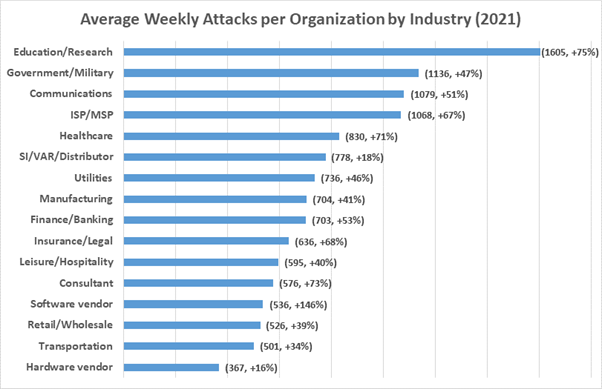
Source: Check Point
The infographic above depicts an estimated total number of cyber-attacks faced by the telecom industry per week. This should give you an idea of the graveness of the situation and the dire need for a security solution to protect the industry and the people’s data it harbors.
Attacks Plaguing the Telecom Industry
Threats can be targeted at a specific telecom company, its third-party providers or the consumers of a telecom service because telecoms are frequently a doorway into many different industries.
Recent prominent attacks on the telecom industry include the ShellClient RAT incident, attacks by LightBasin and LAPSUS$ APT(Advanced Persistent Threat) groups and ransomware hits like the Macaw ransomware incident of 2021.
These assaults take many different shapes. As a result, telecom companies are burdened with alerts generated by EDR and other vulnerability detection services. Below we discuss some of the common attack vectors.
Supply Chain Attacks
Telecom companies rely on external contractors for manufacturing infrastructure services and products. This introduces the risk of falling victim to a supply chain attack. An attack just needs to infect a single weak link in the chain to poison the entire supply chain. The devastative nature of supply chain attacks can be better understood from the case of the SolarWinds hack of 2021.
IoT Attacks
With more linked devices, the application of IoT has boomed, opening up new endpoints. Some of these vulnerabilities are not properly patched, leaving user, client and business accounts vulnerable. Attackers can exploit these endpoints to inject malicious code and potentially take over the connected devices.
Cloud Attacks
Major telecom networks are adopting cloud computing to support and extend business operations. While it eliminates the threat of a physical attack, a poorly managed server can fall prey to a bad actor who can then leverage the access to pivot within the network and establish broader reach.
Human Error
Human error is an almost unpatchable flaw that triggers most of the devastative attacks on any company or industry. Whether enabling macros on a file or clicking on a phishing link, no matter the training provided to employees, there’s always a chance of them falling victim to a cleverly crafted trap. This calls for the need for automation software that detects malicious or suspicious files and URLs and alerts the user of looming threats.
Phishing Attacks
Phishing attacks are a major dilemma for companies to deal with. A staggering 75% of companies in the US reported falling victim to phishing attacks, and on a global scale, phishing cost an estimated 1.8 billion in business losses.
State-sponsored APT Groups
State-sponsored threat actors are the deadliest threats to telecom companies as they act aggressively and with strong motive, supported by resources of government or terrorist groups. Bad actors can remotely infiltrate the infrastructure and take control over physical components to influence critical elements and manipulate data. Moreover, they can acquire and dump sensitive information to be leveraged later for malicious activities.
How Continuous Threat Exposure Management can Secure the Telecom Industry
Continuous Threat Exposure Management uses Risk Identification and Assessment to identify and patch vulnerabilities and secure potentially exploitable vectors. Enterprises can continually and consistently evaluate the visibility, accessibility and vulnerability of an enterprise’s digital assets using five stages: scoping, discovery, prioritization, validation and mobilization. These systems are scalable and can keep up with the pace of asset expansion by persistently monitoring the infrastructure for any unwanted change and mitigating newly-generated flaws that threaten the integrity of the infrastructure.
As the number of susceptible endpoints is reduced, your company’s attack surface is significantly minimized.
This is ever so useful in the telecom industry as the very core of telecommunication revolves around interconnectivity and data transmission. Adopting Continuous Threat Exposure Management is a must to protect telecom companies’ complex infrastructure and intricate networks.
About HivePro Uni5
HivePro Uni5 focuses on Continuous Threat and Exposure Management by using vulnerability as a pivot to assist customers to reduce the attack surface and move away from trying to “fix everything” to fix “what matters”.
HivePro Uni5 provides a true risk score for every vulnerability based on 20+ parameters such as Threat Actor Landscape, Industry Vertical, Geolocation, wormability, exploitability to name a few. This enables enterprises to take decisions on what to Patch Now and what can be Scheduled to Patch Later. To know more about HivePro Uni5, feel free to reach out to us.