Request a Uni5 demo to see how Gartner exposure assessment platforms help teams prioritize, validate, and remediate consequential exposures.
Enterprise security teams rarely lack findings. They lack a defensible way to decide which findings can become viable attack paths, which controls actually interrupt those paths, and which remediation will reduce risk fastest. Gartner exposure assessment platforms address that operating problem by combining broad exposure discovery, threat-informed prioritization, validation, and remediation workflow in one continuous discipline.
Request a Uni5 Xposure demo to evaluate how exposure intelligence can turn an overloaded remediation queue into measurable risk-reduction decisions.
In brief: An exposure assessment platform brings together asset and exposure visibility, business context, threat intelligence, attack-path analysis, validation, and remediation orchestration. For buyers, the decisive test is not how many findings a platform produces. It is whether the platform can prove which exposures are reachable and consequential, route the right action to the right owner, and verify that the fix reduced risk.
What are Gartner exposure assessment platforms?
Gartner's exposure assessment platform category reflects a shift from finding isolated vulnerabilities to continuously assessing exploitable exposure across an organization's attack surface. The category is relevant to security teams that already operate scanners, cloud security tools, application security testing. External attack surface management, and threat intelligence feeds but still struggle to convert their combined output into an ordered remediation plan.
An EAP should establish a continuously updated view of assets and exposures, enrich that view with business and attacker context, and support action. It should help answer three executive questions: Where can an attacker gain leverage? Which path could produce material impact? What intervention will reduce the most risk now?
The category is an operating model, not another scanner
A scanner remains important because discovery quality determines the quality of every downstream decision. However, scan severity alone does not establish business risk. Two assets can carry the same CVE and CVSS score while presenting radically different risk because only one is internet-facing. Reachable from an initial foothold, linked to a critical service, or associated with active exploitation.
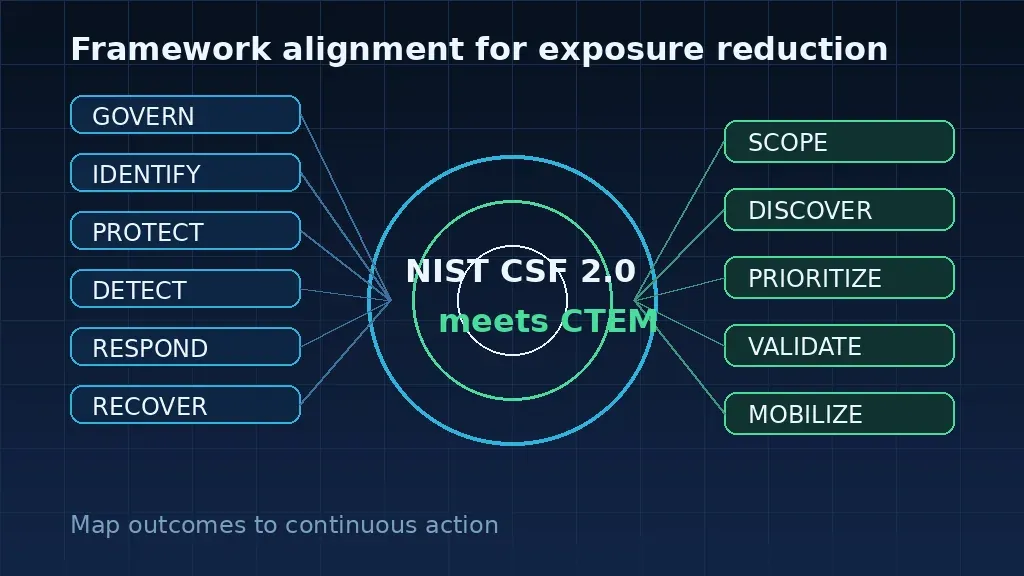
An EAP connects these variables. It can ingest findings from existing tools, normalize overlapping records, associate exposures with assets and owners, and then use threat intelligence and environmental context to prioritize action. This supports a broader continuous threat exposure management program rather than a periodic scan-and-report cycle.
What buyers should expect the platform to produce
- A consolidated exposure inventory across infrastructure, applications, cloud, containers, identities, and external assets.
- Contextual prioritization that accounts for exploit activity, asset criticality, reachability, and compensating controls.
- Validation evidence showing whether an exposure or attack path can be exercised safely.
- Operational workflows that route remediation guidance to accountable teams and track service-level performance.
- Closed-loop verification confirming that remediation or mitigation changed the exposure state.
How EAP differs from traditional vulnerability management
Traditional vulnerability management is usually centered on detecting known software flaws, assigning severity, and tracking remediation. That remains necessary, but it is insufficient for an enterprise attack surface that includes cloud misconfigurations. Exposed credentials, unmanaged internet-facing assets, vulnerable application code, weak controls, and chained attack paths.
| Decision area. | Traditional vulnerability management. | Exposure assessment platform. |
|---|---|---|
| Primary question. | What vulnerabilities exist? | Which exposures create a viable path to material impact? |
| Scope. | Mostly CVEs and scan targets. | Multiple exposure classes. |
| Prioritization. | Severity and age. | Threat activity, reachability, business context, and controls. |
| Validation. | Rescan after a fix. | Safe attack simulation and control validation before and after action. |
| Outcome. | Reduced backlog. | Reduced likelihood and impact of consequential attack paths. |
Why severity-first queues break at enterprise scale
A severity-first program treats a high score as a decision. In reality, it is only one input. Large organizations can have millions of findings across thousands of assets. If teams cannot identify active exploitation, reachable assets, business-critical systems, and effective compensating controls. The highest-severity queue can consume scarce engineering time without addressing the attack paths most likely to matter.
The better unit of work is a risk-reduction decision supported by evidence. For example, the right action may be to patch a reachable vulnerability, isolate an exposed asset, correct a cloud permission, disable a credential, or strengthen a preventive control. EAPs should make these tradeoffs visible and auditable.

Why threat intelligence changes exposure prioritization
Threat intelligence gives exposure data a time dimension. It helps teams distinguish a theoretically severe weakness from an exposure that attackers are actively researching, weaponizing, or exploiting. Combined with reachability and asset context, that intelligence focuses remediation on exposures that are both relevant to the environment and useful to an adversary.
Useful prioritization should incorporate more than a static severity score. It should consider observed exploitation, available exploit code, campaigns, threat actor behavior, attack techniques, and the likelihood that an exposure contributes to a practical chain. These signals change quickly, so prioritization must be continuously refreshed rather than fixed when a ticket is created.
Questions for evaluating threat intelligence
- Does the platform distinguish active exploitation from proof-of-concept availability?
- Can it map threat actor tactics, techniques, and procedures to assets and exposures in the buyer's environment?
- How quickly do changing threat signals update priorities and remediation workflows?
- Can analysts see why a score changed and which evidence drove the decision?
Hive Pro's HiveForce Labs provides vulnerability, threat, threat-actor, and patch intelligence. Uni5 Xposure uses this research alongside business and environmental context to help security teams understand which vulnerabilities are being attacked and exploited. Rather than treating every technical finding as equally urgent.
How should buyers evaluate an exposure assessment platform?
A persuasive demonstration is not the same as an enterprise-ready platform. Buyers should evaluate an EAP against representative data, workflows, and constraints from their environment. The proof of value should begin with a defined decision problem, such as reducing an internet-facing exposure backlog or validating attack paths to a critical service. It should end with measurable evidence that the platform improved that decision.
1. Test coverage and data fidelity
Inventory the exposure sources the platform must support, including existing vulnerability scanners, cloud security tools. Code scanners, container scanners, application testing, external attack surface discovery, and business asset records. Then verify normalization quality. A unified dashboard that duplicates the same finding across tools does not create a useful source of truth.
2. Inspect prioritization transparency
Ask the vendor to explain why a specific exposure is ranked above another. A security team should be able to inspect the contribution of threat activity, asset importance, reachability, exploitability, compensating controls, and potential impact. Opaque risk scores are difficult to defend to asset owners, auditors, and executives.
3. Validate attack paths and controls
Prioritization predicts what matters; validation supplies evidence. Integrated breach and attack simulation can safely test whether controls stop relevant techniques and whether a suspected path is practicable. Hive Pro supports more than 3,700 attack scenarios mapped across the MITRE ATT&CK framework, enabling teams to test control effectiveness and focus remediation on demonstrated gaps.
4. Measure remediation operations
Evaluate how the platform assigns ownership, provides remediation guidance, integrates with tools such as ServiceNow or Jira, manages exceptions, and verifies closure. The proof of value should measure time to decision, accepted remediation rate, reduction in validated attack paths, and repeat exposure rate. A lower finding count alone can hide risk rather than reduce it.
See Uni5 Xposure in action with a proof-of-value scenario built around your existing data sources and remediation process.
What does the Gartner EAP vendor landscape reveal?
The emergence of the category signals that buyers expect more from vulnerability and exposure tooling. Vendors approach the problem from different starting points. Some extend vulnerability scanners, some aggregate findings from multiple controls, and others emphasize attack surface discovery, attack-path analysis, or validation. A category label does not make those architectures interchangeable.
Buyer takeaway: Compare platforms against the exposure types, intelligence sources, validation methods, and remediation workflows that matter to your organization. Analyst recognition can create a shortlist, but architecture fit and proof-of-value evidence should determine the final decision.
Questions that expose architectural differences
- Does the platform provide native assessment as well as third-party data ingestion?
- Can it preserve source evidence while normalizing findings into a unified model?
- Does prioritization account for active attacks, attack paths, asset context, and controls?
- Can teams validate a suspected exposure safely before disrupting production?
- Does the workflow extend through remediation guidance and verification?
Buyers should also assess deployment options, role-based access, data residency, integration depth, auditability, and the performance of the platform on enterprise-scale datasets. These requirements are often more consequential than feature-count comparisons.
How Uni5 Xposure maps to EAP capabilities
Hive Pro's Uni5 Xposure combines native assessment, third-party data consolidation, contextual prioritization, validation, and remediation orchestration. The platform includes native scanning across code, containers, cloud, web applications, networks, mobile applications, and external attack surface discovery. It can also ingest findings from widely used vulnerability, cloud, application security, ITSM, SIEM, and collaboration tools.
Prioritize with business and attacker context
Uni5 Xposure's Unictor AI engine adds context beyond raw severity. It draws on a vulnerability database of more than 210,000 CVEs, intelligence on more than 270 tracked threat groups, asset criticality, real-world attack activity, and environmental factors. The objective is to help teams identify the subset of exposures that warrants immediate action while preserving a clear explanation of the decision.
Validate before and after remediation
Attack-path analysis shows how weaknesses can combine into routes toward critical assets. BAS then helps validate whether relevant techniques can succeed and whether controls interrupt them. This gives security and infrastructure teams evidence for prioritization and a way to confirm that remediation changed the result.
Operationalize a closed loop
Bi-directional APIs and workflow integrations support ticket creation, collaboration, reporting, and verification. Remediation guidance helps owners understand the required action, while closed-loop verification checks whether the exposure was resolved. This connects security posture management to accountable operational work.
From category research to a defensible buying decision
An effective EAP selection process begins with a specific risk-reduction objective, not a generic request for better visibility. Define the attack surface and workflows in scope, identify the decisions the platform must improve, and agree on measurable success criteria with security, infrastructure, application, and risk stakeholders.
- Define the risk-reduction decision the platform must improve.
- Test representative exposure data and integrations.
- Validate attack paths and control effectiveness safely.
- Measure remediation speed and verified risk reduction.
During evaluation, use real samples from the environment. Check whether the platform finds assets other tools missed, deduplicates exposures accurately, changes priorities when threat intelligence changes, identifies actionable attack paths, and verifies remediation. Document both improvements and false positives. That evidence will support procurement, implementation planning, and future program reporting.
Key takeaway: Gartner exposure assessment platforms should be judged by the quality and speed of the decisions they enable. The winning platform is the one that helps your organization repeatedly identify consequential exposure, validate the risk, coordinate the right response, and prove that the response worked.
Frequently asked questions
What is an exposure assessment platform?
An exposure assessment platform continuously discovers and consolidates exposures, enriches them with threat and business context, and supports prioritization, validation, remediation, and verification. It expands the decision model beyond isolated vulnerabilities to include how assets, controls, configurations, identities, and attack paths combine to create risk.
How is an EAP different from vulnerability management?
Vulnerability management primarily detects and manages known software flaws. An EAP uses vulnerability data but adds broader exposure coverage, contextual prioritization, attack-path analysis, control validation, and closed-loop remediation. It helps teams decide which action reduces the most consequential risk rather than simply addressing the highest raw severity.
Does Gartner category recognition replace a proof of value?
No. Analyst recognition can help establish a shortlist and clarify category expectations, but it does not prove fit for a specific environment. Buyers should test representative data sources, prioritization logic, integrations, validation methods, scale, and remediation outcomes before selecting a platform.
Why does threat intelligence matter in exposure assessment?
Threat intelligence reveals which vulnerabilities, techniques, and assets are attracting attacker attention. When combined with asset importance and reachability, it helps teams focus on exposures that are both relevant and likely to be exploited. It also allows priorities to change as the threat environment changes.
What role does BAS play in an EAP program?
Breach and attack simulation safely tests whether security controls can stop relevant attack techniques and whether suspected paths are viable. That evidence helps teams validate prioritization, justify remediation, and confirm that a fix or control change reduced exposure.
Turn exposure assessment into action
Move beyond severity-driven queues and evaluate exposure management against measurable risk reduction. Request a Uni5 Xposure demo to see how Hive Pro combines threat intelligence, attack-path analysis, BAS, and remediation orchestration in a continuous exposure assessment workflow.