Request a Mandiant vs Hive Pro comparison. See how exposure visibility, threat-based prioritization, BAS validation, and remediation workflows differ.
A ranked backlog still fails if it points teams at the wrong exposure first. Security leaders comparing platforms need proof that priority leads to action, validation, and measurable risk reduction.
Contact Hive Pro to discuss how a proactive CTEM workflow can support your exposure management goals.
Mandiant vs Hive Pro is a comparison of how security teams turn exposure data into prioritized remediation before an intrusion demands attention. Mandiant Attack Surface Management documents external asset discovery, continuous monitoring, active checks, shadow IT identification, multicloud asset discovery, and assessment of high-velocity exploit impact. Hive Pro positions Uni5 Xposure as a complete CTEM platform connecting Scope, Discover, Prioritize, Validate, and Mobilize, with integrated Breach and Attack Simulation (BAS). The right choice depends on whether your primary need is external attack surface visibility or a unified exposure-to-remediation operating cycle.
This guide uses publicly documented Mandiant capabilities and Hive Pro's documented platform model. Then maps both against the questions CISOs and vulnerability management leaders should ask during an evaluation.
Mandiant vs Hive Pro: the core CTEM difference
In a Mandiant vs Hive Pro review, the useful question is not which name sounds stronger. It is how the security team wants to manage exposure work. Some teams will assess Mandiant Attack Surface Management within an existing security workflow. Others may want one CTEM workflow centered on continuous action and validation.
A fair review should begin with the team's process. List who finds exposure, who tests it, who sets repair order, and who tracks the fix. Then ask whether an option supports that full path or fits into the tools already in place.
A workflow question
Exposure management starts before an incident occurs. CISA advises organizations to identify and remove exposed weaknesses before attackers use them. Buyers can apply a simple test. Can the approach find risk, set priorities, test what matters, and move fixes forward?
Hive Pro presents the Uni5 Xposure platform as one platform for five CTEM stages: Scope, Discover, Prioritize, Validate, and Mobilize. Its customer materials state that the platform includes BAS for validation. Workflow design is a fair basis for comparison.
Side-by-side operating model
| Comparison point | Mandiant ASM documented focus | Hive Pro documented focus |
|---|---|---|
| Starting point | External asset discovery through an adversary view. | CTEM workflow from scoping through mobilization. |
| Visibility | Continuous monitoring, technology identification, active checks, and multicloud or shadow IT discovery. | Native scanning plus aggregated security data within a unified exposure view. |
| Priority signal | Assess impact of high-velocity exploits in the discovered attack surface. | Threat-based and context-aware prioritization. |
| Validation | Confirm the validation scope needed during evaluation. | Integrated BAS within the Validate stage. |
| Operational question | How will ASM findings feed existing remediation work? | How will the full CTEM cycle operate as one ongoing program? |
Priority and validation fit
Priority should be tied to current threat evidence, not just a long list of findings. CISA recommends that organizations monitor its Known Exploited Vulnerabilities catalog and prioritize flaws known to be exploited. A buyer can ask how that signal enters daily decisions.
The right fit depends on the operating model the team can sustain. Choose after testing visibility, priority logic, validation, and the path from a finding to a fix.
What Mandiant Attack Surface Management documents
External discovery through an adversary view
Mandiant Attack Surface Management should be evaluated on its documented scope, not on assumptions about its wider portfolio. The official Google Cloud page positions Mandiant ASM around seeing an organization through the eyes of an adversary. For teams with internet-facing services, acquired domains, multicloud workloads, or shadow IT concerns, that is a relevant starting point.
The documented feature set includes continuous monitoring, technology and service identification, outcome-based asset discovery, and active asset checks. The page also names high-velocity exploit impact assessment, shadow IT identification, and multicloud asset discovery as common uses. Mandiant states that asset discovery and analysis can be conducted daily, weekly, or on demand.
Questions for an ASM-led evaluation
These capabilities can matter when the first challenge is building reliable external visibility. Buyers should ask for evidence in their own environment: which assets are identified, what previously unknown exposure appears. How the service detects change, and how findings are routed to an accountable remediation owner.
- Can the evaluation identify unknown external assets and confirm ownership?
- Can it distinguish an active service from stale or duplicated inventory?
- Can teams see why an emerging exploit changes the urgency of a finding?
- Can the output connect to the team's remediation and reporting workflow?
Where it sits in the broader decision
Attack surface management is important, but discovery alone is not the full exposure-management decision. Security leaders still need a defensible priority order, a method for testing likely paths, and proof that remediation lowered risk. This is where a comparison against a complete CTEM operating model becomes useful.
In a Mandiant vs Hive Pro assessment, use Mandiant's published ASM capabilities as evidence for external discovery. Then examine how each evaluated approach carries those findings into prioritization, validation, and action.
What should teams evaluate in an exposure management platform?
A Mandiant vs Hive Pro review should start with operating needs, not feature counts. Teams need to know what is exposed and what to fix first. They also need proof that fixes reduce risk.
Attack surface visibility
Begin with coverage. An exposure management platform should map assets across cloud services, endpoints, identities, applications, and internet-facing systems. Ask how it finds unmanaged assets, joins scanner results, removes duplicate findings, and keeps ownership clear.
Visibility should support a working CTEM process, rather than another alert feed. Buyers can use Hive Pro's overview of a Continuous Threat Exposure Management platform to shape their review. The goal is a repeatable view of exposure that teams can act on.
Threat-based priorities and validation
A long vulnerability list does not show where attackers are most likely to act. Look for priority rules that join asset value, exposure, controls, and active exploitation. The platform should explain why a finding moved to the top of the queue.
One useful test is how the platform handles CISA's Known Exploited Vulnerabilities catalog. Ask if KEV status raises priority and creates a clear action that remains visible in reports. Next, assess validation. The platform should help teams test whether a likely attack path can reach a key asset.
Remediation workflow and reporting
Priorities only matter when they reach an owner. Check whether the platform assigns work, links to ticketing tools, tracks exceptions, retests fixes, and records risk acceptance. Security teams should not rebuild the same context in several tools.
- Can analysts trace each priority to threat context and affected assets?
- Can owners see the needed action and verify that the fix worked?
- Can leaders see whether risk is falling over time?
How does Hive Pro operationalize CTEM?
A continuous CTEM workflow
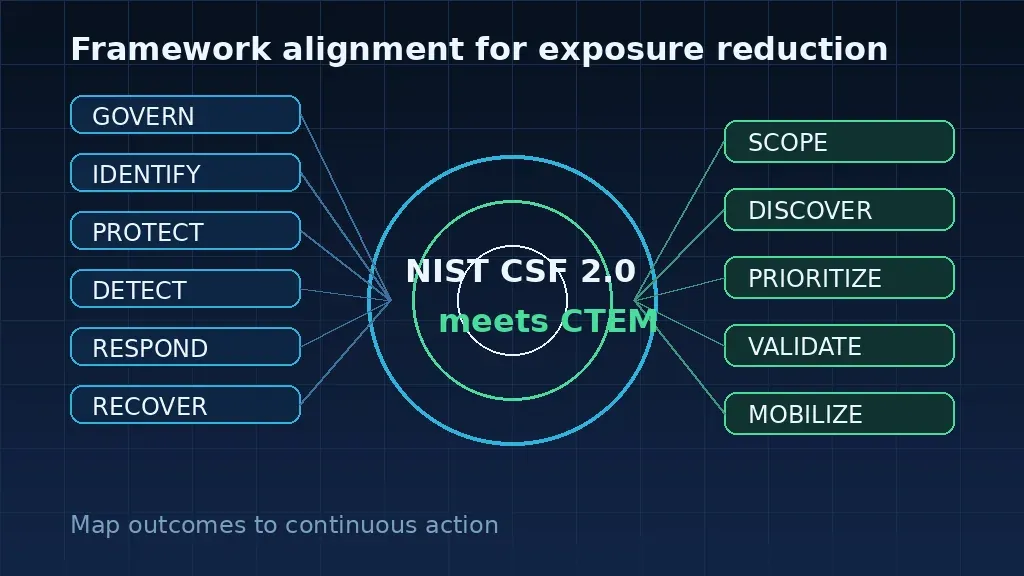
In a Mandiant vs Hive Pro review, CTEM becomes a practical point of comparison. Hive Pro frames exposure management as a repeatable cycle, not a scan followed by a static report. Its Uni5 Xposure platform aligns work to five CTEM stages: Scope, Discover, Prioritize, Validate, and Mobilize.
This approach matters when teams face changing threats across a large environment. A CTEM program must keep findings tied to current threat context and response action.
The five operational stages
- Scope: Set the assets, business services, and attack surfaces that require review across applicable environments.
- Discover: Find assets and exposures through native scanning, then bring related security data into one working view.
- Prioritize: Sort findings by threat context and likely attack paths, rather than relying on raw severity scores alone.
- Validate: Use integrated BAS to test whether security controls stop a relevant attack path.
- Mobilize: Route validated issues into remediation workflows so owners can fix, track, and retest urgent gaps.
Data, validation, and action
Discovery needs broad input, but more findings are not the final goal. According to Hive Pro's platform materials, Uni5 Xposure includes six native scanners and aggregates data from more than 50 third-party tools. This design lets security and IT operations data feed one exposure view.
Validation makes the ranked list testable. Uni5 Xposure uses integrated BAS for security control validation, checking whether defenses can interrupt a modeled attack path. Mobilize turns those findings into remediation work and a basis for retesting.
Need to evaluate this workflow in your environment? Talk to Hive Pro about CTEM priorities and validation requirements.
When is a platform-led CTEM approach the better fit?
A platform-led CTEM approach fits teams whose exposure picture changes faster than periodic review cycles can track. It supports a steady workflow for scoping, discovery, prioritization, validation, and action across changing assets and controls.
Broad and changing attack surfaces
Large enterprises do not manage a fixed perimeter. Cloud workloads, internet-facing systems, identities, and third-party connections can shift the exposure picture between reviews. A new public service, changed cloud route, or exposed control can alter the order of work. CTEM keeps attention on current exposure and possible impact, rather than a static backlog.
Prioritized remediation and validation
Tool fragmentation makes that task harder. Findings may sit in separate tools while security leaders need one risk view for planning and follow-up. Teams assessing a threat-based prioritization approach should consider whether one CTEM workflow reduces handoffs from discovery to remediation.
Validation matters after prioritization. Teams need evidence that a chosen control or fix reduces the route an attacker could use. A program that joins prioritization with validation can keep the queue tied to tested exposure paths.
A practical fit decision
Choose a platform-led approach when the goal is an ongoing exposure program and the team needs a repeatable way to connect exposure data to remediation. For external discovery priorities, evaluate Mandiant ASM against the required attack surface scope. For an integrated CTEM path, assess whether Hive Pro meets coverage, validation, integration, and reporting requirements in a proof of value.
What should you ask before selecting an exposure management solution?
A Mandiant vs Hive Pro evaluation should start with your operating needs, not a feature list. Ask each provider to show how its approach maps exposed assets to action. The goal is a process your team can run, measure, and defend in budget reviews.
Asset coverage and risk context
First, define what must be seen. Ask which internet-facing, cloud, identity, endpoint, and third-party assets appear in one view. Ask how unknown assets are found, assigned to an owner, and checked again after change.
- Can we see which asset, exposure, and business service are linked?
- Can we sort by active threat evidence and asset importance?
- Can we trace why one item should be fixed before another?
Validation and remediation workflow
Priority is useful only when the team trusts it. Ask what validation method tests whether an exposure can affect a key system. Ask what proof reaches the security analyst and the application owner, without forcing either group to interpret raw alerts.
Remediation also needs named ownership. Ask who receives a fix ticket, which service level applies, how exceptions are approved, and how successful repairs are retested. Request a workflow demo using an asset type common in your environment.
Integration and reporting fit
No platform works alone. Ask which scanners, ticketing tools, cloud sources, asset systems, and threat feeds connect today. Require details on data sync timing, failed imports, duplicate assets, role controls, and export options.
Finally, ask what leaders will see after a quarter. A useful report shows owned risk, validated priorities, open remediation work, accepted exceptions, and change over time. It should let a CISO explain where exposure fell, where it remains, and which team owns the next step.
Choosing the right exposure management path
Start with the operating need
A Mandiant vs Hive Pro decision should start with the work your team must run each week. Some organizations primarily need a stronger external attack surface view. Others need a steady operating motion that finds exposures, ranks work, tests risk, and routes fixes across teams.
Map that need before comparing product labels. Ask whether the program must cover assets, find exposures, rank priorities, validate attack paths, and move fixes forward. Hive Pro presents Uni5 Xposure as a complete CTEM platform built around those linked tasks.
Match capabilities to decisions
- Scope: Define the cloud, endpoint, application, identity, and external assets that require coverage.
- Priority: Decide which threat evidence must shape the queue beyond a raw severity score.
- Validation: Require a way to confirm whether urgent exposures create reachable risk.
- Mobilization: Confirm how findings become owned fixes tracked through closure.
For teams seeking one proactive CTEM motion, workflow continuity is the key question. Readers can compare platform elements through Hive Pro's Continuous Threat Exposure Management overview.
No provider is right for every environment. The sound choice matches assets, staffing, validation needs, remediation ownership, and proof obtained during evaluation.
Frequently Asked Questions
What is the main difference between Mandiant and Hive Pro for CTEM?
The main comparison is how each option turns exposure findings into action. Mandiant ASM documents external visibility and attack surface discovery capabilities. Hive Pro's Uni5 Xposure is designed to cover Scope, Discover, Prioritize, Validate, and Mobilize in one CTEM platform. Teams should test both against required coverage, threat context, validation, remediation workflow, and reporting.
Does proactive CTEM replace specialist security expertise?
No. Proactive CTEM helps teams identify, prioritize, validate, and route exposures continuously. Specialists still set scope, interpret business impact, approve remediation tradeoffs, and respond when an attack occurs. Automation can narrow the work queue and provide evidence, while practitioners decide which actions are safe and urgent.
How does threat-based prioritization differ from relying on CVSS alone?
CVSS rates technical severity, but it cannot by itself show whether attackers are exploiting a flaw or whether the affected asset matters most to the business. Threat-based prioritization adds evidence such as active exploitation and exposure context. CISA recommends prioritizing remediation for vulnerabilities in its Known Exploited Vulnerabilities catalog.
Why does BAS matter in CTEM?
BAS, or Breach and Attack Simulation, matters because CTEM should verify risk, not simply list possible weaknesses. BAS tests whether relevant attack techniques can succeed through current controls, helping teams confirm which exposures require action first. Hive Pro states that Uni5 Xposure includes integrated BAS for validation.
Ready to prioritize exposures before risk spreads?
Waiting for exposure priorities to become clear can keep security teams focused on issues that are easier to see, not the decisions that deserve action first. A focused evaluation can align platform requirements, validation needs, and remediation workflows.
Ready to focus on exposures that call for action first? Contact Hive Pro to discuss a proactive CTEM strategy and decide how validated exposure management can support your next security decision.