Request a demo to strengthen SOC 2 cybersecurity with continuous exposure management, prioritized remediation, and audit-ready evidence.
Point-in-time audit preparation leaves security teams proving controls with evidence that may already be stale. Continuous exposure management keeps that proof current as threats, assets, and vulnerabilities change.
Request a demo to see how Hive Pro supports continuous, audit-ready SOC 2 cybersecurity evidence.
SOC 2 cybersecurity becomes a continuous practice when Continuous Threat Exposure Management (CTEM) tracks assets, threats, control gaps, and remediation evidence throughout the audit period. CTEM continuously discovers exposures, prioritizes actively exploited flaws, validates defenses, and records remediation. Auditors receive current proof that controls work while teams address risks most likely to affect customer data.
The question is not whether controls passed once, but whether teams can prove those controls remain effective as exposure changes. To see why that distinction matters, the next section explains why SOC 2 cybersecurity needs continuous evidence. The practical path begins with
SOC 2 cybersecurity needs continuous evidence
A point-in-time check shows whether a control worked during one review. It does not show what changed the next day. New assets, exposed services, and active threats can shift risk long before the next audit window.
Evidence between audit windows
SOC 2 cybersecurity evidence should show that controls keep working, not just that a team passed a scheduled test. Continuous Threat Exposure Management (CTEM) builds that record through repeated discovery, prioritization, validation, and response. Each cycle shows what the team found, why it mattered, and what action followed.
This approach matches the goal of security control monitoring. NIST guidance on continuous monitoring calls for visibility into assets, threats, vulnerabilities, and control effectiveness. That visibility helps teams spot weak controls early and respond before gaps become long-lived audit issues.
A snapshot can also hide the pace of change. A control may pass when tested, then fail after a new system or access rule appears. Repeated checks reveal that drift and create dated proof of the response.
Risk-based proof of action
A long list of open flaws is not useful evidence by itself. Auditors and security leaders need context that explains which exposures pose real risk. Threat intelligence adds that context by showing which flaws attackers actively use and which assets face the greatest threat.
CTEM turns this context into a clear chain of decisions. A team can use a SOC 2 compliance risk assessment to set priorities, then connect each choice to proof of validation and remediation.
- Discovery records show which assets and exposures were in scope.
- Priority records explain why the team addressed one risk before another.
- Validation results show whether an exposure was exploitable or a control worked.
- Remediation records show ownership, action, and follow-up testing.
From security work to audit evidence
Continuous evidence makes routine security work easier to review. Instead of rebuilding the story before an audit, teams can retain a current trail of findings and decisions. That trail links each exposure to its business context, response owner, fix status, and validation result.
The result is a stronger view of control health over time. It also helps compliance and security teams work from the same risk picture. A consistent continuous monitoring for SOC 2 process keeps evidence current while giving leaders a practical way to track gaps and response progress.
How CTEM supports the SOC 2 Trust Services Criteria
Continuous Threat Exposure Management (CTEM) helps security teams connect changing exposures to the controls examined during a SOC 2 audit. This approach turns scattered findings into clear, risk-based work and a steady record of action.
The link is practical, not automatic. CTEM does not grant compliance, but it helps teams show how they find, rank, test, and fix threats over time.
Security as the common foundation
Security is the required Trust Services Criterion and supports the other four criteria. CTEM maps assets, finds exposed paths, and ranks weaknesses using threat intelligence and business context.
Validation adds proof that a weakness creates a real attack path before teams spend time on it. This process supports a focused SOC 2 compliance risk assessment and gives auditors a clear reason for each repair decision.
That context helps teams focus on exposures tied to key services and sensitive data. It also keeps low-risk findings from hiding the issues that need prompt action.
CTEM contributions across the criteria
Each criterion asks a different question, but the same exposure record can support several control areas. The table shows where CTEM fits and which evidence a team can retain.
| Trust Services Criterion | Exposure-management contribution | Example evidence |
|---|---|---|
| Security | Finds, ranks, and validates attack paths | Asset inventory, ranked exposure queue, validation results |
| Availability | Flags exposures that may disrupt key services | Critical asset scope, remediation tickets, retest results |
| Processing integrity | Finds weaknesses that could affect system processing | Control test records, exposure changes, closure proof |
| Confidentiality | Maps exposed routes to restricted data and systems | Attack-path maps, access findings, fix history |
| Privacy | Highlights routes that may expose personal data | Data-linked findings, risk decisions, verified repairs |
The strongest evidence shows a full chain from discovery to verified repair. Teams should keep the finding, risk basis, owner, action, and retest result together.
Shared evidence also reduces repeat work across control areas. One verified repair may support several criteria when its record shows the affected assets, data, and services.
Continuous evidence for auditors
A point-in-time scan can show what existed on one date. CTEM creates an ongoing view of assets, threats, weak controls, and remediation progress.
This model aligns with NIST guidance on information security continuous monitoring, which calls for visibility into assets, threats, vulnerabilities, and control effectiveness. It also helps teams build a more useful continuous monitoring for SOC 2 process.
For audit readiness, teams can export evidence by criterion, control, asset, owner, or time period. That structure makes control gaps easier to trace and repair before an auditor asks for proof.
A practical CTEM workflow for SOC 2 readiness
A practical Continuous Threat Exposure Management (CTEM) workflow turns SOC 2 cybersecurity work into a repeatable operating cycle. It connects each exposure to a control, an owner, and clear proof of action. This approach replaces last-minute evidence hunts with records built during daily security work.
Scope and risk decisions
Start with systems, data flows, vendors, and controls that fall within the audit scope. Use a documented SOC 2 compliance risk assessment to set risk limits and assign owners. The scope should reflect business impact, not just a list of known assets.
Define the scope. Map in-scope services, sensitive data, control goals, and business owners. Record why each asset matters to the audit.
Discover exposures. Find assets, misconfigurations, vulnerable software, and exposed services across the scoped environment. Recheck often so new assets do not remain unseen.
Prioritize real risk. Rank findings by business impact, control relevance, active threats, and likely attack paths. This keeps urgent work ahead of low-risk scan noise.
Validate the exposure. Confirm whether an attacker can use the weakness and reach a valuable target. Safe validation helps teams avoid spending time on false positives.
Remediate with ownership. Assign the fix, due date, and control reference to a named owner. Track accepted risks and exceptions with clear reasons and approval.
Capture evidence. Keep test results, tickets, approvals, timestamps, and proof that each fix worked. Link each record to the related SOC 2 control.
Report and repeat. Show open risk, overdue fixes, control health, and risk trends to security and compliance leaders. Feed lessons into the next scope review.
Evidence that follows the work
Evidence capture should happen inside the workflow, not weeks before the audit. Store the original finding, the risk decision, remediation records, and validation results together. A shared record lets auditors trace how the team found and managed each material exposure.
This evidence also supports ongoing control checks. NIST guidance says continuous monitoring should provide visibility into assets, threats, vulnerabilities, and control effectiveness. Teams can use the NIST continuous monitoring guidance to shape review cycles and reporting.
Continuous reporting and improvement
Dashboards should show whether controls work over time, not just whether teams closed tickets. Track exposure age, remediation status, validation outcomes, exceptions, and changes in audit scope. These views make gaps clear before an auditor asks for proof.
Connect reporting to regular security and compliance reviews. A strong continuous monitoring for SOC 2 process helps leaders see when risk changes and act before evidence becomes stale.
How do threat intelligence and BAS strengthen SOC 2 evidence?
Threat intelligence focuses SOC 2 evidence on vulnerabilities that attackers actively exploit, while breach and attack simulation validates whether controls stop realistic attack paths. Together, they show auditors why remediation was prioritized, whether defenses worked, and how teams verified each fix against real exposure.
Evidence tied to real exposure
Threat intelligence helps teams separate urgent exposures from long lists of possible weaknesses. It adds context about active attacks, known attacker methods, and the assets most likely to face harm. That context makes each remediation choice easier to explain during a SOC 2 cybersecurity audit.
Teams can connect each priority to an affected asset, a relevant threat, and the control meant to reduce risk. This creates a clear chain from discovery through action. Hive Pro's approach to risk-based vulnerability management explains how active exploitation can guide patch priorities.
- The threat or attack method that raised the priority
- The exposed asset and its business role
- The selected control, owner, and planned fix
- The evidence captured after remediation
Control validation through BAS
Breach and attack simulation (BAS) safely tests whether selected controls can stop or detect realistic attack steps. A scan may show that a weakness exists. BAS goes further by checking whether that weakness creates a usable path and whether defenses respond as planned.
This validation gives security teams direct proof instead of relying only on policy documents or control settings. Useful records include the test scope, attack path, control response, result, and time stamp. A failed test also creates a clear remediation item that teams can assign, fix, and test again.
Continuous Threat Exposure Management (CTEM) links this work into a repeatable cycle of prioritization, validation, and action. It helps teams turn SOC 2 compliance risk assessment findings into proof that controls face practical tests.
Auditor-ready records over time
Auditors need evidence that shows how a control worked during the review period, not just how it was designed. Threat intelligence records explain why a risk received attention. BAS results show how the related control behaved when tested.
Together, these records form a traceable evidence set: risk context, test method, result, response, owner, and retest outcome. Teams should retain approvals and changes beside those records. This makes it easier to show that findings led to timely action.
NIST guidance on continuous monitoring calls for visibility into assets, threats, vulnerabilities, and the effectiveness of deployed controls. That model supports a stronger audit trail. It also helps teams spot weak controls between formal audit checks, while evidence is still current and useful.
Talk to Hive Pro about turning exposure validation into defensible SOC 2 evidence.
What evidence should security teams give SOC 2 auditors?
Security teams should give SOC 2 auditors dated evidence that connects each control to its scope, owner, test result, remediation decision, and validated outcome. The evidence set should show continuous asset coverage, prioritized exposures, control effectiveness, closed findings, and documented exceptions throughout the review period.
Coverage and control records
Start with an asset inventory that defines the audit scope. Keep discovery logs, ownership records, and coverage reports for cloud assets, endpoints, applications, and other in-scope systems. Coverage reports should also flag blind spots, stale records, and assets that lack an assigned owner.
Pair that inventory with control validation records. Useful artifacts include scan results, attack simulation results, alert samples, access reviews, and change logs. NIST guidance says continuous monitoring should provide visibility into assets, threats, vulnerabilities, and control effectiveness. This makes NIST continuous monitoring guidance a useful reference when teams define their evidence set.
- Asset counts by type, owner, business unit, and monitoring status
- Control test date, method, result, evidence file, and responsible owner
- Coverage gaps, planned fixes, due dates, and current status
Risk decisions and remediation proof
Auditors need more than a list of open findings. Retain the risk score, business context, threat intelligence, priority, owner, and target date for each finding. Teams should also record why one issue moved ahead of another. A documented SOC 2 compliance risk assessment gives reviewers the context behind those choices.
For closed findings, keep evidence from discovery through validation. That trail may include a ticket, approval, patch record, configuration change, retest result, and closure date. Report remediation time by risk level and show overdue items separately. These records help auditors test whether response rules were followed in practice.
Exceptions need the same care. Record the reason, affected assets, approving owner, compensating controls, expiry date, and review history. Do not let an accepted risk become an open-ended waiver. A clear expiry and review trail show that the team still manages the exposure.
Trends and audit-ready reporting
Trend reports turn separate artifacts into a control story. Show changes in asset coverage, validation pass rates, open findings, overdue remediation, exception age, and repeat issues. Add short notes for major changes so an auditor can understand why a metric rose or fell.
Use stable report definitions across the audit period. If a metric changes, retain the old definition and explain the update. A guide to continuous monitoring for SOC 2 can help teams build a repeatable reporting cycle instead of collecting evidence at the last minute.
Finally, map each artifact to the related control, system, owner, and review date. Store evidence in a controlled location with clear file names and access history. This simple index helps auditors sample records faster and helps security teams find missing proof before fieldwork begins.

Common SOC 2 vulnerability management gaps
SOC 2 cybersecurity controls can look sound on paper while daily vulnerability work leaves clear gaps. Teams often scan, patch, and report, yet still struggle to show that controls reduce real risk over time.
Point-in-time scanning
An annual scan offers a snapshot, not proof that controls work between audit dates. New assets, software changes, and emerging threats can make that snapshot stale soon after it is taken.
This approach also turns evidence collection into a rushed audit project. By contrast, NIST guidance on continuous monitoring calls for visibility into assets, threats, vulnerabilities, and control effectiveness. CTEM applies that ongoing view to exposure management, so teams can track findings and fixes as conditions change.
Weak scope and misleading counts
A scan cannot assess an asset that the team does not know exists. Weak scope may omit cloud services, internet-facing systems, temporary workloads, or assets owned outside the security team. A strong SOC 2 compliance risk assessment starts with a clear inventory and defined business context.
Raw vulnerability totals create another gap. A falling count may look positive even when an exposed, actively exploited flaw remains open. It can also push teams toward easy fixes instead of the exposures most likely to affect sensitive systems.
CTEM addresses both issues through repeated scoping, discovery, and prioritization. It links asset context with threat intelligence, then directs work toward exposures that pose real risk. This risk-based vulnerability management approach gives auditors a clear reason for why teams fixed one issue before another.
Unsupported decisions and scattered evidence
Risk acceptance becomes a control gap when it lacks an owner, business reason, review date, or supporting data. An auditor cannot assess a decision that exists only in email or in an analyst's memory.
Evidence also loses value when scan results, tickets, validation records, and approvals sit in separate tools. Teams then spend audit time rebuilding a timeline instead of showing how the control operated. Disconnected records can also hide missed handoffs and overdue work.
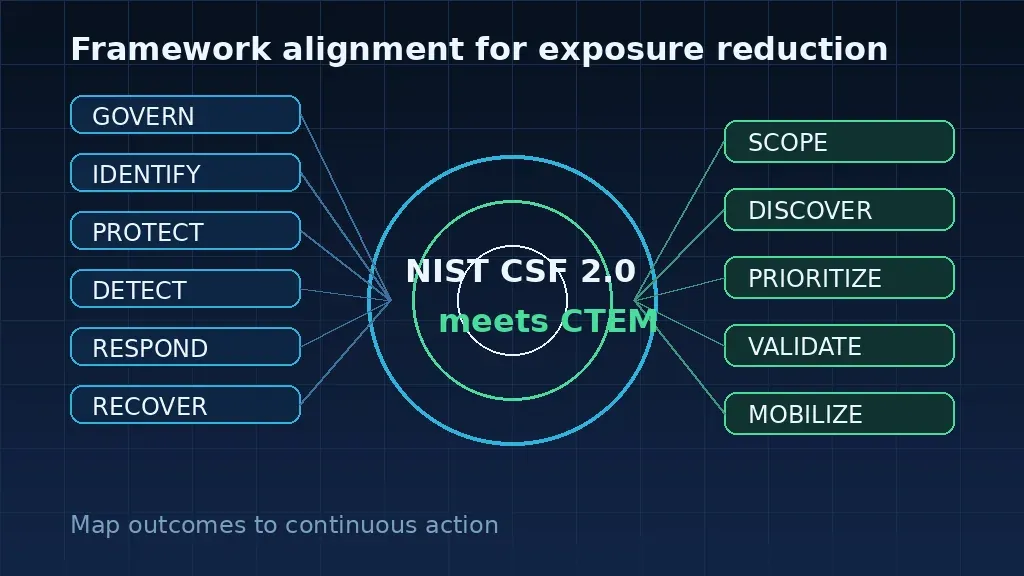
CTEM connects prioritization, validation, and mobilization into a repeatable record. Each accepted or fixed exposure should show its asset, risk basis, owner, action, validation result, and review history. That record makes control operation easier to trace without treating the audit as a once-a-year event.
Building an audit-ready continuous exposure program
An audit-ready program treats SOC 2 cybersecurity as an ongoing operating practice, not a rush before the audit window. Continuous Threat Exposure Management (CTEM) gives teams a repeatable cycle for finding exposures, testing risk, fixing issues, and recording proof.
Start by linking each in-scope asset and exposure to a control, owner, and evidence requirement. This approach supports the visibility into assets, threats, vulnerabilities, and control health described in NIST guidance for continuous monitoring.
Clear ownership and evidence rules
Assign one program owner who can resolve gaps across security, IT, engineering, and compliance. Then name control owners for each system or process. Control owners fix issues and provide evidence, while compliance staff check that records meet audit needs.
Define evidence rules before the program begins. Each record should show the affected asset, exposure, risk decision, assigned owner, action taken, validation result, and date. Keep proof in a shared system with access controls and a clear retention policy.
- Security teams manage discovery, threat context, prioritization, and validation.
- IT and engineering teams own fixes, accepted exceptions, and change records.
- Compliance teams map evidence to controls, review gaps, and prepare audit samples.
- Business owners approve risk decisions that affect critical services or customer data.
A repeatable CTEM operating cycle
Run the program through scope, discovery, prioritization, validation, and mobilization. Use threat intelligence to rank exposures that attackers are using, rather than treating every finding as equal. Hive Pro's guide to risk-based vulnerability management explains how threat context can focus remediation work.
Set a review cadence that matches business risk. High-risk findings may need daily review, while control owners can review broader trends each week. Hold a monthly governance meeting to address overdue fixes, repeated failures, exceptions, and changes to the audit scope.
After remediation, validate that the exposure is no longer usable and save the result with the original record. This step connects a closed ticket to proof that the control worked. It also helps teams find recurring weaknesses before an auditor selects a sample.
KPIs that show control health
Choose measures that show both risk reduction and evidence quality. A continuous monitoring for SOC 2 workflow should give leaders a current view of control health, ownership, and unresolved risk.
- Coverage: share of in-scope assets mapped to owners, controls, and current evidence.
- Response: time from discovery to triage, assignment, remediation, and validation.
- Risk: count and age of exploitable exposures on critical assets.
- Quality: share of closed findings with complete, approved, and retrievable proof.
- Governance: overdue actions, expired exceptions, repeated findings, and missed reviews.
Set a target, review frequency, and escalation rule for every KPI. Trends matter more than a one-time score. Leaders should investigate missed targets, record the decision, assign follow-up work, and track it through validation.
Frequently Asked Questions
Is SOC 2 a cybersecurity audit?
Yes, a SOC 2 audit examines whether a service organization's controls protect customer data and related systems. It covers cybersecurity through the security criterion and may also assess availability, processing integrity, confidentiality, and privacy. As Palo Alto Networks explains, SOC 2 is both a compliance and privacy standard.
Who can perform a SOC 2 audit?
Only an independent certified public accountant, or CPA, or an accounting firm can perform a SOC 2 audit. Internal security and compliance teams prepare controls, collect evidence, and address gaps before the assessment. However, the final examination and report must come from an eligible independent auditor, according to Palo Alto Networks.
What is a SOC 2 compliance checklist?
A SOC 2 compliance checklist organizes the work needed to prepare for an audit and maintain effective controls. It typically covers scope, Trust Services Criteria, policies, control owners, evidence collection, testing, remediation, and monitoring. NIST guidance supports continuous monitoring that provides visibility into assets, threats, vulnerabilities, and control effectiveness.
What is the difference between SOC 2 Type I and Type II?
A SOC 2 Type I report assesses whether controls are suitably designed at a specific date. A Type II report assesses both control design and operating effectiveness across a defined review period. Continuous threat exposure management can support Type II readiness by producing ongoing evidence of monitoring, prioritization, validation, and remediation.
Ready to make SOC 2 readiness continuous?
Waiting for the next audit cycle allows unresolved exposures and scattered evidence to create more work for security and compliance teams. Starting now gives your team time to build repeatable review habits, address priority gaps, and organize clear evidence before auditors request it. A continuous approach also helps leaders track progress throughout the year instead of rushing to rebuild the compliance story before each assessment.
Move from reactive audit preparation to a steady program that supports faster decisions and clearer accountability. Request a demo to see how Hive Pro can help your team manage exposures and maintain audit-ready evidence.