Tenable Competitors: An Enterprise Evaluation Guide


Choosing a vulnerability-management platform is no longer only about scan frequency or the size of a findings database. Enterprise teams also need to understand which assets matter most, connect evidence across security tools, and move validated priorities into remediation workflows. That makes a fair comparison less about naming a universal winner and more about matching platform design to the organization's environment, operating model, and risk strategy.
Book a Demo to see how an exposure-management platform can fit your security operating model.
The strongest tenable competitors should be evaluated on asset coverage, data integration, risk-based prioritization, validation, workflow support, and fit with the broader exposure-management program, not on feature count alone.
NIST CSF 2.0 similarly emphasizes understanding, assessing, prioritizing, and communicating cybersecurity risk rather than prescribing one implementation. The first step is to define what the team actually needs the platform to do. Start with criteria that separate a scanner from a broader exposure-management capability.
What should you look for in Tenable competitors?
Start with the security problem your team needs to solve, not with a list of feature names. A scanner identifies vulnerabilities in a defined scope. An exposure-management platform can combine findings from multiple tools, add business and threat context, and help teams decide what to do next. An orchestration layer may focus primarily on coordinating assignments, remediation, and evidence across existing systems. Those categories can overlap, but they are not interchangeable.
A useful evaluation lens should therefore test whether a candidate fits your risk-management model and operating environment. NIST Cybersecurity Framework 2.0 helps organizations understand, assess, prioritize, and communicate cybersecurity efforts. It does not prescribe one implementation path. (NIST CSF 2.0) Use that flexibility to define requirements around outcomes. Do not assume the largest feature set is the best fit.
Asset and environment coverage
Ask what the platform can see and how it maintains that view. Your evaluation should include hardware, software, services, systems, network communications, data flows, and supplier-provided services where they affect enterprise risk. NIST calls for inventories of managed hardware, software, services, and systems, along with representations of authorized internal and external network data flows. It also emphasizes managing assets according to their importance to organizational objectives and risk strategy. A useful proof of value should reveal coverage gaps, duplicate records, stale assets, and ownership problems.
Risk context and prioritization
Do not stop at vulnerability discovery or severity labels. Ask how the candidate accounts for asset classification, criticality, available resources, and mission impact. The platform should help analysts connect a technical finding to the business context that determines whether it deserves immediate action, planned remediation, compensating controls, or documented acceptance. It should also make the reasoning visible enough for security leaders and asset owners to understand.
Validation and operating fit
Test whether findings can be validated, assigned, tracked, and reported through the workflows your teams already use. Review integration breadth, data normalization, deployment model, exception handling, and total cost of ownership. A candidate that creates another isolated queue may add work even if its scanner is capable. Conversely, an organization may not need to replace an existing scanner if a broader platform can use its data effectively.
In short, the strongest Tenable competitors are evaluated by coverage, context, validation, and workflow fit. Choose the option that produces actionable outcomes for your environment, not simply more findings.
Scanner, platform, or orchestration layer: what are you replacing?
Many enterprise teams searching for tenable competitors are not actually looking for the same category of product. A scanner discovers vulnerabilities in a defined set of assets. An exposure-management platform combines findings with asset context, risk signals, and validation so teams can decide what deserves attention. An orchestration layer coordinates the work across tools and owners. These functions can overlap, but they solve different operating problems.
Start by documenting what the current environment already does. If the immediate gap is incomplete coverage or unreliable vulnerability identification, a scanner may be the right replacement or addition. If the organization has multiple scanners but still lacks a coherent view of exposure, replacing one scanner may simply preserve the underlying fragmentation. A platform that ingests and normalizes existing findings can sometimes improve decision quality without requiring every collection tool to be removed.
NIST CSF 2.0 provides a useful neutral benchmark for this distinction. It calls for vulnerabilities to be identified, validated, and recorded, while also requiring risk responses to be chosen, prioritized, planned, tracked, and communicated. Those are related activities, but they are not the same activity. NIST CSF 2.0 can therefore help buyers test whether a product supports only discovery or the broader operating process.
How the three layers differ in an enterprise security architecture| Layer | Primary job | Questions for buyers | When it may be insufficient alone |
|---|---|---|---|
| Vulnerability scanner | Inspect selected assets and identify potential vulnerabilities. | What assets, environments, and vulnerability types can it assess? Can findings be validated and recorded? | It may not provide enough business, threat, or workflow context to prioritize enterprise exposure. |
| Exposure-management platform | Combine exposure data with asset and risk context to support prioritization and validation. | Can it normalize data, represent coverage, explain priority, and show evidence of risk reduction? | It may depend on scanners and other data sources for collection. |
| Orchestration layer | Coordinate assignments, remediation plans, exceptions, tracking, and communication across teams. | Can it connect findings to owners, systems, deadlines, approvals, and status evidence? | Workflow automation cannot compensate for poor asset coverage or unreliable findings. |
Answer capsule: The right replacement target depends on the bottleneck. Replace or add a scanner when collection is the problem. Add an exposure-management platform when teams cannot turn fragmented findings into defensible priorities. Add orchestration when the analysis is sound but remediation remains slow, disconnected, or difficult to verify. NIST also calls for changes and exceptions to be assessed for risk impact, recorded, and tracked, making governance part of the evaluation rather than an afterthought. That distinction helps buyers compare architecture fit instead of treating every alternative as a one-for-one scanner swap.
How does threat intelligence change prioritization?
Answer: Threat intelligence turns a vulnerability list into a risk-ranked action plan by showing which weaknesses are being exploited, how likely exploitation is, what assets are exposed, and whether remediation has reduced the real attack path.
A scanner can identify a CVE, but the finding alone does not explain what deserves attention first. Threat intelligence adds current adversary context. NIST recommends receiving cyber threat intelligence from information-sharing forums and other sources, then identifying internal and external threats and recording the potential impact and likelihood of exploitation. Those inputs help security teams prioritize risk responses rather than treating every high-severity finding as equally urgent. NIST CSF 2.0
The CISA Known Exploited Vulnerabilities (KEV) catalog is a practical signal for this process. CISA describes it as an authoritative source of vulnerabilities exploited in the wild and recommends using it as an input to an organization's vulnerability-management prioritization framework. A vulnerability listed in KEV should receive immediate review, especially when it affects an internet-facing system. An identity service, a sensitive application, or an asset supporting a critical business process. CISA's KEV catalog
Asset criticality supplies the second half of the decision. A known exploited vulnerability on a disposable test host is not the same operational risk as the same vulnerability on a production payment system or privileged access infrastructure. NIST says assets should be prioritized according to classification, criticality, available resources, and mission impact. That means an evaluation of tenable competitors should examine whether the platform can connect findings to reliable asset ownership, business context, exposure, and dependencies, not simply whether it produces another severity score.
Validation keeps prioritization grounded after remediation begins. NIST calls for vulnerabilities to be identified, validated, and recorded. Teams should be able to confirm whether a vulnerable component is actually present. Whether a compensating control changes the exposure, and whether a patch or configuration change closed the relevant path. CISA also notes that KEV entries include evidence of active exploitation and a clear remediation action, while recommending automated tools that can flag or prioritize those entries. CISA remediation guidance
For enterprise buyers, this is the difference between threat-informed vulnerability prioritization and a static queue. Look for transparent signals, adjustable business context, evidence behind risk scores, and a feedback loop that rechecks exposure after action. The strongest approach helps analysts explain why an item moved to the top and what proof shows it can move back down.
Which workflow and orchestration capabilities matter?
Answer capsule: The strongest workflow layer turns prioritized exposure data into accountable action. It should assign remediation to the right owner, preserve the reasoning behind each decision, support exceptions without losing visibility, and verify that risk has actually been reduced.
A useful evaluation starts with the handoff between security and the teams that must make changes. Findings should be grouped by asset, application, business owner, or remediation action rather than delivered as an undifferentiated queue. Look for routing rules that can assign work to infrastructure, cloud, application, or endpoint teams while retaining the original evidence, severity context, affected asset, and recommended response. Ownership should be explicit, with due dates, status changes, and escalation paths that match the organization's operating model.
Automation matters, but only when it is tied to a decision. CISA recommends considering automated vulnerability and patch-management tools that incorporate, flag, or prioritize vulnerabilities in its Known Exploited Vulnerabilities (KEV) catalog. CISA's guidance on KEV remediation gives teams a practical benchmark: automation should help surface urgent items, not simply create more tickets.
Can teams manage exceptions without creating blind spots?
Every enterprise has legitimate exceptions. A patch may be incompatible with a critical application, an asset may be scheduled for retirement, or a compensating control may reduce immediate exposure. The workflow should record the reason, approver, scope, expiration date, and residual risk. NIST CSF 2.0 calls for changes and exceptions to be managed, assessed for risk impact, recorded, and tracked. That makes exception management a governance capability, not a way to dismiss findings permanently.
Validation is the other half of remediation. After a fix, the platform should support rescanning, evidence collection, or another defensible verification step. A closed ticket is not proof that an exposure is gone. The result should show what was tested, when it was tested, which asset was affected, and whether the finding was resolved, reduced, or still present. NIST likewise describes risk responses as chosen, prioritized, planned, tracked, and communicated, so reporting should make progress legible to both technical teams and leadership.
Do integrations preserve context across the handoff?
Assess integrations by asking whether data flows in both directions. A mature workflow can ingest findings from existing scanners and security tools, normalize overlapping records, and send actionable work into the systems teams already use. It should also return status and validation evidence to the exposure-management view. This approach allows existing scanners to remain part of the architecture while adding orchestration above them. Hive Pro's Uni5 Xposure platform is positioned around that type of unified exposure and remediation workflow.
For teams comparing tenable competitors, the key question is not how many connectors appear on a feature sheet. It is whether the complete chain, from finding to owner to verified outcome, is reliable, auditable, and adaptable when priorities change.
How do alternatives support a unified CTEM program?
Answer capsule: The strongest alternatives are not defined by replacing one scanner. They support a unified Continuous Threat Exposure Management (CTEM) model by connecting asset scope, discovery, prioritization, validation, and mobilization while fitting the tools and workflows an enterprise already operates.
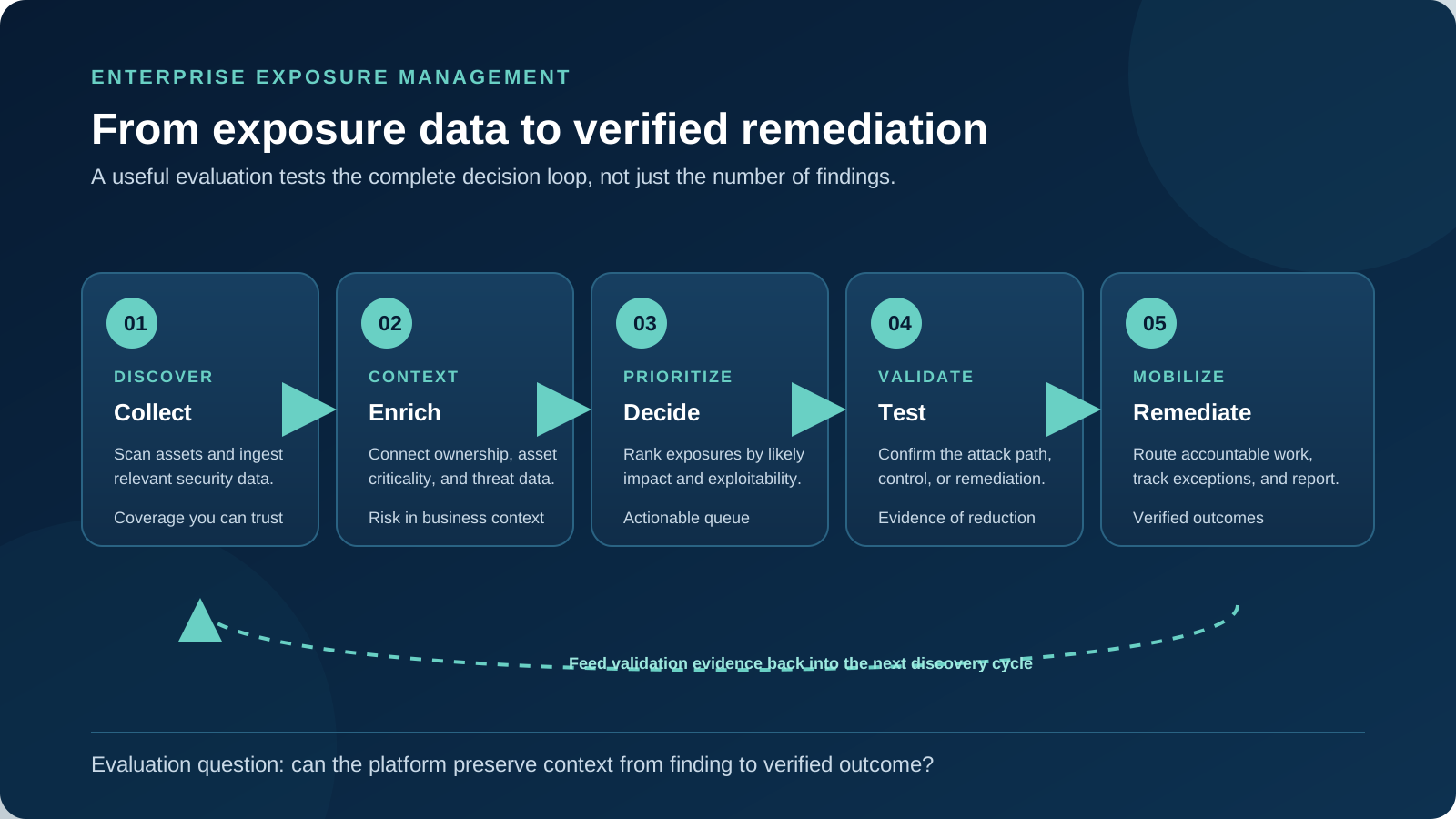
Scenario comparison: If a team lacks reliable cloud and container coverage, prioritize a platform with native cloud and container scanners rather than an aggregation-only layer. If scanners already cover the environment but analysts cannot prove which findings are exploitable, prioritize threat-intelligence enrichment and integrated breach and attack simulation or attack-path validation. If prioritization is sound but remediation stalls, prioritize bidirectional ITSM orchestration with owner routing, exception expiry, and verification feedback. These scenarios reveal whether a candidate adds missing capability or simply duplicates an existing tool.
Start with scope. A CTEM program needs a defensible view of what the organization is protecting, not only what a vulnerability scanner can reach. NIST CSF 2.0 calls for inventories of managed hardware, software, services, systems, supplier-provided services, and relevant network data flows. It also recommends prioritizing assets according to classification, criticality, available resources, and mission impact. An alternative platform may help aggregate these views, normalize findings from existing tools, or add native coverage for areas that are otherwise difficult to monitor. The right question is not whether a vendor claims universal visibility. It is which environments it covers, how that coverage is verified, and where another system remains authoritative.
Next, examine how the platform moves from discovery to a decision. A unified model should relate vulnerabilities and other exposures to the asset, its business importance, and the risk-management objectives of the organization. That can include data from scanners, cloud and endpoint systems, external attack surface sources, or other security controls. The integration layer matters because disconnected findings create duplicate work and make it harder to see whether the same exposure affects several business-critical assets.
Validation is the next dividing line. NIST recommends that vulnerabilities be identified, validated, and recorded, rather than treated as equally actionable entries in a queue. During evaluation, ask how a product confirms an exposure, records evidence, handles false positives, and shows whether remediation changed the risk. Some alternatives may emphasize scanning, while others may focus on exposure correlation or validation. Those are complementary roles, not interchangeable product categories.
Finally, mobilization turns analysis into an operating process. NIST says risk responses should be chosen, prioritized, planned, tracked, and communicated. It also calls for changes and exceptions to be assessed for risk impact, recorded, and tracked, with processes for responding to vulnerability disclosures. Look for integrations that assign work to the right owner, preserve exception rationale, support approvals, and return status to security leadership. Reporting should show movement from exposure to accountable action, not just a larger count of findings.
For a fuller distinction between the operating model and traditional scanning, review this guide to CTEM and vulnerability management. In practice, a unified CTEM architecture may retain established scanners while adding normalization, context, validation, and workflow coordination around them. That fit is often more important than selecting a platform with the longest feature list.
A practical evaluation checklist for enterprise security teams
A useful proof-of-value should test how a platform improves decisions and execution in your environment, not simply how many findings it displays. Start with a representative scope: business-critical applications, cloud assets, endpoints, network infrastructure, and the teams responsible for remediation. Include existing scanners where they remain valuable, then evaluate whether the candidate improves the surrounding exposure-management process.
- Define the decision you need the platform to support. Document the outcomes that matter to security leadership and operations. Examples include identifying the exposures most likely to lead to compromise, assigning accountable owners, validating remediation, and producing evidence for governance. NIST describes its Cybersecurity Framework as guidance for understanding, assessing, prioritizing, and communicating cybersecurity efforts, rather than a prescriptive implementation model. Use that same principle: judge each product against your risk-management objectives, not a generic feature checklist. Read the NIST CSF 2.0 guidance.
- Test asset and data coverage. Measure what the platform can discover, ingest, normalize, and keep current across hybrid and multi-cloud environments. Check hardware, software, services, systems, network context, suppliers, and externally exposed assets. NIST emphasizes maintaining inventories and prioritizing assets according to classification, criticality, resources, and mission impact. Ask for evidence of coverage gaps and duplicate records, rather than accepting a claim of broad visibility.
- Recreate a threat-informed prioritization exercise. Provide a sample of vulnerabilities with different asset criticality, exploitability, and business impact. Confirm that the system can distinguish urgent exposure from technically severe but lower-context findings. CISA identifies its Known Exploited Vulnerabilities (KEV) catalog as an authoritative source for vulnerabilities exploited in the wild and recommends using it as an input to vulnerability-management prioritization. Check whether KEV status and other threat intelligence are visible, explainable, and actionable in the analyst workflow, not merely present in a report. Review CISA's KEV catalog.
- Validate the remediation loop. Track one issue from detection through ownership, exception review, remediation, and verification. Confirm that risk responses can be chosen, prioritized, planned, tracked, and communicated. Test how the platform records changes and exceptions, including approval, expiration, residual risk, and audit evidence. A proof-of-value should show whether the tool reduces manual coordination without hiding unresolved exposure.
- Check integration, deployment, and operating fit. Evaluate APIs, identity controls, ticketing, SIEM and SOAR connections, data retention, deployment requirements, and administrator effort. Ask who maintains integrations and how failures are surfaced. Finally, model total cost of ownership using your actual users, data sources, workflow volume, and operating responsibilities. Do not assume the newest platform or the largest feature set is the right choice for every team.
Answer capsule: The strongest evaluation of Tenable competitors is a controlled, threat-informed proof-of-value that measures coverage. Prioritization quality, validation, workflow execution, integration effort, and governance fit against your own risk objectives.
Book a Demo to evaluate your exposure-management options with Hive Pro.
Frequently Asked Questions
What should you compare when evaluating Tenable competitors?
Compare more than scanner features. Assess asset and environment coverage, integrations, data normalization, prioritization context, validation, remediation workflows, deployment fit, reporting, and total cost of ownership. Also determine whether the product replaces a scanner, adds an exposure-management layer, or orchestrates work across tools.
Do you need to replace your existing vulnerability scanners?
Not necessarily. An exposure-management platform can ingest findings from scanners already deployed, normalize the data, add business and threat context, and coordinate remediation. Retaining existing scanners may be the better choice when they provide useful coverage or fit established operating procedures.
How should threat intelligence affect vulnerability prioritization?
Threat intelligence should help distinguish theoretical severity from practical exposure. CISA identifies its Known Exploited Vulnerabilities catalog as an authoritative source of vulnerabilities exploited in the wild and recommends using it as an input to vulnerability-management prioritization: CISA KEV guidance. Combine that signal with asset criticality, exposure, exploit likelihood, and available remediation options.
What should an enterprise include in a proof-of-value test?
Use representative assets, cloud and on-premises environments, existing scanner data, and real remediation workflows. Test ingestion, normalization, prioritization, validation, assignment, exception handling, integrations, and evidence for leadership reporting. Define success criteria before the evaluation so the decision reflects operational improvement rather than a feature checklist.
Ready to compare your exposure management options?
A structured evaluation can help your team determine whether a scanner, exposure management platform, or orchestration layer best fits your current security program. Review how the approach supports visibility, prioritization, validation, and remediation workflows before making a platform decision. To discuss your requirements with the Hive Pro team, Book a Demo.



.svg)