Nucleus Security vs Hive Pro: CTEM Comparison


Choosing between Nucleus Security vs Hive Pro is really a decision about how your security team wants to run exposure management: as an aggregation and workflow layer over existing tools, or as a broader CTEM platform that combines aggregation, native discovery, threat intelligence, validation, and remediation in one operating model.
Book a demo to see how Hive Pro's Uni5 Xposure platform helps security teams prioritize, validate, and remediate the exposures that matter most.
Both platforms are built for teams that have outgrown traditional vulnerability management. Both aim to reduce the noise that comes from scanners, asset tools, cloud systems, and ticket queues. Both speak to CISOs and vulnerability management leaders who need a practical way to move from massive finding lists to measurable risk reduction.
The difference is in the center of gravity. Nucleus Security is known for unifying third-party vulnerability and asset data, normalizing it, and operationalizing remediation workflows. Hive Pro's Uni5 Xposure platform is built around the full Continuous Threat Exposure Management program, with native scanning, third-party aggregation, HiveForce Labs threat intelligence, Breach and Attack Simulation, and mobilization workflows in one platform.
This comparison breaks down where each platform fits, how they differ across CTEM stages, and when Hive Pro may be the stronger Nucleus Security alternative for enterprise exposure management.
Nucleus Security vs Hive Pro at a Glance
For a quick comparison, the clearest distinction is that Nucleus Security emphasizes exposure data unification and workflow automation, while Hive Pro emphasizes end-to-end exposure management with built-in validation and native discovery.
CategoryNucleus SecurityHive Pro Uni5 XposureCore positionVulnerability and exposure management platform focused on data unification, prioritization, and remediation workflowsContinuous Threat Exposure Management platform covering scope, discover, prioritize, validate, and mobilizeData modelIngests and normalizes data from many security and asset toolsCombines native scanners, EASM, and third-party integrations into one exposure viewIntegrationsStrong integration ecosystem, including a published integration directory and FlexConnect frameworkIntegrates with major security tools while also reducing dependence on external scanners through native coverageNative scanningBest understood as an aggregation and orchestration layer over existing toolsIncludes native scanners for code, container, cloud, web, network, mobile, plus EASMBreach and Attack SimulationNot positioned as a native BAS platformBAS is included as a core validation capabilityThreat intelligenceUses threat-informed prioritization and intelligence enrichmentPowered by HiveForce Labs, which adds global, industry, regional, and exploit-focused threat contextBest fitTeams that want to unify many existing scanners and operationalize remediationTeams that want a complete CTEM operating platform with discovery, prioritization, validation, and remediation in one place
That summary matters because exposure management is not one feature. It is a program. The right platform should support how your team discovers exposures, decides what matters, proves what is exploitable, and mobilizes remediation across owners.
What Nucleus Security Does Well
Nucleus Security has a clear strength: centralizing fragmented vulnerability and exposure data. Its platform messaging focuses on ingesting, normalizing, deduplicating, enriching, and operationalizing data from a broad ecosystem of security and asset tools.
For organizations that already own multiple scanners and posture tools, that can be valuable. Vulnerability management often breaks down because findings live in too many places. Network scanner data sits in one system. Cloud findings sit in another. Application security results sit somewhere else. Tickets are created manually, asset ownership is unclear, exceptions are hard to track, and leadership cannot tell whether exposure is actually going down.
Nucleus addresses that operational pain by acting as a system of record for vulnerability and exposure data. Its public integration directory lists a large set of supported categories, including network scanners, cloud security, SAST, DAST, SCA, asset inventory, ticketing, and threat intelligence sources. Its platform also describes a data fabric approach designed to connect findings, assets, ownership, threat context, and remediation workflows.
That makes Nucleus a strong option for teams whose highest priority is normalizing existing tools and improving vulnerability operations without replacing much of their current stack.
Where Hive Pro Takes a Different Approach
Hive Pro starts from a broader CTEM premise: security teams should not only collect exposure data, they should continuously reduce the exposures most likely to be exploited against the business.
That is why Uni5 Xposure is built around the full CTEM lifecycle rather than only the vulnerability operations layer. Hive Pro unifies external and internal discovery, vulnerability data, asset context, threat intelligence, attack validation, and remediation mobilization so security teams can answer a more important question: which exposures create the most realistic attack paths to critical assets?
Hive Pro's approach combines three things that are often separated in enterprise environments:
- Native discovery: code, container, cloud, web, network, mobile, and external attack surface management capabilities.
- Third-party aggregation: ingestion from major security tools and scanners already deployed in the environment.
- Validation and prioritization: HiveForce Labs intelligence, contextual risk scoring, and Breach and Attack Simulation to prove which exposures are exploitable.
This is the main reason Hive Pro is positioned as more than another dashboard. It is designed to help teams consolidate tools, validate risk, and operationalize remediation from one CTEM platform.
CTEM Stage Coverage: Which Platform Supports the Full Program?
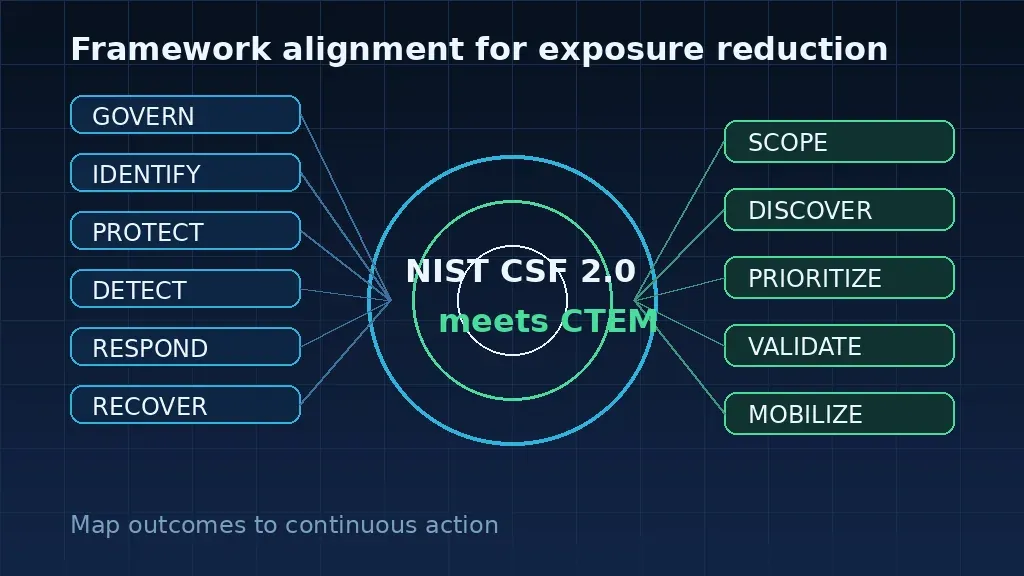
Gartner's CTEM framework is commonly described across five stages: scope, discover, prioritize, validate, and mobilize. A platform can support exposure management in one or two stages and still leave the security team stitching together the rest of the program manually.
Here is how the comparison typically breaks down.
1. Scope
Scoping is about deciding what matters most: critical business services, crown jewel assets, exposed applications, cloud workloads, identities, and environments that create meaningful business risk.
Nucleus helps by connecting asset and exposure data from existing systems. Hive Pro also connects asset and exposure data, but its CTEM model is designed to map that scope into an operational exposure management program. For teams building a program around the five stages of CTEM, that matters because scope has to drive prioritization, validation, and remediation decisions downstream.
2. Discover
Discovery is one of the biggest differences in the Nucleus Security vs Hive Pro comparison. Nucleus is strongest when an organization already has scanner data to ingest. Hive Pro can ingest third-party data too, but it also includes native scanners across code, container, cloud, web, network, and mobile environments, plus external attack surface management.
That gives Hive Pro an advantage for teams trying to reduce tool sprawl or fill discovery gaps without adding another point product. If your security program depends on many separate scanners, an aggregation layer can help. If you want aggregation plus native discovery coverage, Hive Pro offers a more consolidated model.
3. Prioritize
Both platforms move beyond raw CVSS. That is table stakes in modern exposure management. The real question is which signals are used to decide what matters.
Nucleus describes AI-powered vulnerability intelligence and threat-informed prioritization. Hive Pro prioritizes exposures using vulnerability severity, asset criticality, business impact, attack feasibility, exploitability, environmental context, and threat intelligence from HiveForce Labs. This is especially important when teams are trying to escape the trap of patching every critical CVE in the same way.
For a deeper view of this concept, see Hive Pro's guide to threat intelligence for exposure management. The short version is simple: prioritization improves when it reflects what attackers are actually exploiting, not just what a scanner labels severe.
4. Validate
Validation is where Hive Pro separates itself most clearly. Prioritization tells you what appears risky. Validation tells you whether an exposure can realistically be used in an attack path.
Hive Pro includes Breach and Attack Simulation for exposure management, allowing teams to test defenses against attacker behavior and validate which weaknesses could be exploited in practice. That makes remediation decisions more defensible because teams can focus on exposures that are not only theoretically severe, but operationally relevant.
Nucleus is not typically positioned as a native BAS platform. For teams that need validation, that can mean adding a separate BAS product, integrating results, and maintaining another workflow. Hive Pro reduces that friction by making validation part of the same exposure management workflow.
Schedule a Hive Pro demo to see how built-in BAS helps validate which exposures create real attack risk.
5. Mobilize
Mobilization is about turning prioritized risk into action. Both Nucleus and Hive Pro support remediation workflows, ownership, and ticketing. This is one reason they are both more operationally useful than scanner-only products.
The difference is what feeds the workflow. In Nucleus, the workflow is powered primarily by normalized third-party findings and enrichment. In Hive Pro, remediation can be driven by native discovery, third-party ingestion, business context, HiveForce Labs intelligence, and BAS validation. That broader input set can help teams create fewer, better remediation actions instead of flooding IT and engineering teams with tickets.
Integrations vs Native Capabilities: The Practical Tradeoff
The strongest argument for Nucleus Security is integrations. If an enterprise already has a large set of security tools and wants to preserve that architecture, a mature ingestion model is valuable. Nucleus publishes a broad integration ecosystem and offers FlexConnect for custom data sources.
But integrations alone do not solve every exposure management problem. They can also preserve the complexity that created the problem in the first place. If every critical capability depends on another tool, teams still manage scanner licensing, tool maintenance, data quality issues, conflicting scores, and gaps between systems.
Hive Pro takes a hybrid route. It supports integrations with existing tools, but it also gives teams native discovery capabilities. That matters in three scenarios:
- Tool consolidation: teams want to reduce the number of platforms required to run vulnerability and exposure management.
- Coverage gaps: teams do not have reliable discovery across cloud, applications, containers, mobile, network, or external attack surface.
- Operational speed: teams need one platform to detect, prioritize, validate, and mobilize remediation without stitching together multiple products.
If your organization is committed to keeping every existing scanner, Nucleus may fit the current operating model. If your organization wants to modernize the operating model, Hive Pro is the more complete exposure management platform comparison point.
Threat Intelligence: Generic Enrichment or Actionable Exposure Context?
Threat intelligence is easy to mention and hard to operationalize. Most platforms can enrich findings with exploit data, malware associations, or external signals. The harder task is translating that intelligence into clear remediation decisions for a specific environment.
Hive Pro's differentiation is HiveForce Labs, its in-house threat intelligence and research capability. HiveForce Labs helps connect vulnerability data to active exploitation, attacker behavior, industry patterns, regional threat context, and indicators that security teams can use to detect exploitation. That makes threat intelligence part of prioritization and validation, not a separate feed that analysts have to interpret manually.
For security leaders, this distinction matters because the business does not need more vulnerability trivia. It needs evidence that the team is fixing the exposures most likely to become incidents.
When Nucleus Security May Be the Better Fit
An honest comparison should acknowledge where Nucleus can make sense. Nucleus Security may be a better fit if:
- Your organization already has a mature scanner ecosystem and does not want to replace or consolidate tools.
- Your biggest pain is normalizing third-party vulnerability data into a single operational workflow.
- You need a flexible ingestion layer across many data sources and custom workflows.
- You are not prioritizing native BAS as part of the same exposure management platform.
In that environment, Nucleus can improve visibility, deduplication, ownership, ticketing, and reporting across the tools already in place.
When Hive Pro Is the Stronger Nucleus Security Alternative
Hive Pro is the stronger Nucleus Security alternative when the goal is not just better vulnerability operations, but a complete CTEM program.
Hive Pro is especially compelling if your team wants to:
- Consolidate vulnerability scanning, exposure management, threat intelligence, and BAS into one platform.
- Reduce dependence on separate scanners by using native code, container, cloud, web, network, mobile, and EASM capabilities.
- Prioritize exposures using business context, threat context, asset criticality, and attack feasibility.
- Validate exposures through Breach and Attack Simulation before mobilizing remediation.
- Move from reactive vulnerability management to continuous exposure reduction.
Hive Pro is also a natural next step for teams evaluating broader exposure management cybersecurity platforms and trying to understand which vendors support the full CTEM lifecycle.
How to Evaluate Both Platforms in a Proof of Concept
A proof of concept should test more than dashboard screenshots. The right evaluation should show whether the platform changes how your team makes decisions.
Use these questions when comparing Nucleus Security vs Hive Pro:
- Discovery: Can the platform find exposures directly, or does it depend entirely on third-party scanners?
- Data quality: How well does it normalize, deduplicate, and connect findings to assets and owners?
- Prioritization: Which signals influence risk scoring beyond CVSS?
- Validation: Can the platform prove exploitability or control effectiveness through BAS?
- Threat intelligence: Does intelligence translate into action, or does it simply add more context?
- Remediation: Are tickets fewer, clearer, and tied to business impact?
- Program fit: Does the platform support all five CTEM stages, or only part of the lifecycle?
- Tool economics: Will the platform consolidate tools, or add another layer on top of the existing stack?
Talk to Hive Pro if your evaluation criteria include native scanning, BAS validation, HiveForce Labs intelligence, and full CTEM coverage.
Bottom Line: Nucleus Security vs Hive Pro
Nucleus Security is a capable platform for teams that want to centralize vulnerability and exposure data from many existing tools, enrich it, and operationalize remediation. It fits organizations that are invested in their current scanner ecosystem and need a stronger system of record for vulnerability operations.
Hive Pro is the better fit for teams that want exposure management to become a complete CTEM program. Its Uni5 Xposure platform brings together native discovery, third-party aggregation, HiveForce Labs threat intelligence, BAS validation, and remediation workflows so teams can focus on the exposures most likely to affect the business.
If your evaluation is mainly about integrating more tools, Nucleus deserves a look. If your evaluation is about reducing real exposure with fewer handoffs, stronger validation, and broader CTEM stage coverage, Hive Pro is the stronger choice.
Common Buying Questions
Is Hive Pro a Nucleus Security alternative?
Yes. Hive Pro is a Nucleus Security alternative for organizations that want exposure management, vulnerability prioritization, remediation workflows, and CTEM capabilities in one platform. The biggest distinction is that Hive Pro also includes native scanning and Breach and Attack Simulation.
Does Hive Pro integrate with existing security tools?
Yes. Hive Pro integrates with major vulnerability scanners and security tools while also offering native scanners. That hybrid model lets teams keep critical existing tools while reducing gaps and tool sprawl over time.
Why does BAS matter in exposure management?
BAS matters because it validates whether an exposure can realistically be used by an attacker. Without validation, teams may prioritize based on severity or theoretical risk. With BAS, they can focus on exposures that create real attack paths and control failures.
Which platform is better for CTEM?
For teams focused on the full CTEM lifecycle, Hive Pro is stronger because it supports scope, discover, prioritize, validate, and mobilize in one platform. Nucleus is strong for aggregation and workflow, but Hive Pro adds native discovery and BAS validation as part of the same CTEM operating model.