Ransomware Went Malware-Free. Your Detection Stack Didn't Get the Memo.


Ransomware Went Malware-Free. Your Detection Stack Didn't Get the Memo.
Ransomware-as-a-Service is no longer a threat category — it's a functioning economy with supply chains, specialists, and market pricing for your attack surface. The industry's answer has been more detection. The data says detection is watching the wrong movie.
Critt Golden · Global Director of Pre-Sales, North America — HivePro · July 2026Here is the number that should end the "detect and respond" era as a standalone strategy: according to CrowdStrike's own Global Threat Report, roughly four out of five initial access attacks now involve no malware at all. Attackers log in with stolen credentials, live off legitimate tools, and move through your environment looking exactly like your own administrators. And consider who published it: the market leader in endpoint detection, reporting that most intrusions are invisible to the thing endpoint detection was built to see.
This isn't an argument that EDR is useless. It's an argument that EDR is positioned at the end of the ransomware kill chain, waiting for a payload that increasingly never announces itself until the encryption event. By then, the intrusion is weeks old and the data is already gone. The problem isn't your detection engineering — it's the economics of the adversary you're detecting.
RaaS Isn't a Threat. It's an Economy.
Ransomware-as-a-Service took the SaaS playbook and applied it to extortion. Operators build the platform — the encryptor, the leak site, the victim "support" portal — and license it to affiliates who run the actual intrusions, typically keeping 70–80% of every ransom. It's a franchise model. The operator is corporate; the affiliate is the franchisee; and the thing being franchised is access to you.
What makes this durable isn't the malware. It's the specialization. The modern ransomware supply chain has fully decoupled its stages:
| Actor | Role in the Supply Chain | What It Means for Defenders |
|---|---|---|
| Initial Access Brokers | Compromise networks at scale using infostealer credentials, exposed VPNs, and unpatched edge devices, then sell footholds on dark-web markets. | Your exposures have a literal market price. Access to your network may be listed for sale days or weeks before the intrusion escalates. |
| RaaS Operators | Build and maintain the ransomware platform, leak infrastructure, and affiliate program. | Takedowns kill brands, not the ecosystem. LockBit was disrupted; the affiliates migrated and the model persisted. |
| Affiliates | Buy access, escalate privileges, exfiltrate data, detonate — or increasingly, skip encryption and extort on stolen data alone. | They don't need to be skilled at everything. They need one unvalidated gap in your control stack. |
The IAB layer is the one that should keep exposure teams up at night. Verizon's 2026 DBIR found that 73% of ransomware victims showed infostealer or credential-leak activity in the year before the breach, with a median of roughly 95 days between credential harvest and ransomware deployment. Three months. The access existed, was packaged, was sold, and sat waiting — while the victim's dashboards showed green.
"The IAB market is your attack surface, priced and listed. The question is whether you find your exposures before your buyer does."
The Math That Broke Detection
For the first time in the DBIR's 19-year history, vulnerability exploitation overtook stolen credentials as the number-one initial access vector — jumping to 31% of breaches. The driver: edge devices and VPN appliances, whose share of exploitation-driven breaches exploded roughly eight-fold in a single year, from 3% to 22%. These are the exact assets where EDR agents don't run, where firmware patch cycles are measured in maintenance windows, and where the median time from CVE disclosure to mass exploitation is now effectively zero days.
Sit with that asymmetry. The adversary weaponizes a disclosed CVE in hours. The median defender remediates in 32 days — and barely half of edge vulnerabilities ever get fully remediated at all. Insurance claims data makes the consequence concrete: Coalition found remote access services were the entry point in 87% of ransomware claims, with VPN compromise alone accounting for roughly three-quarters of intrusions where a vector was identified.
Now overlay the detection problem. The affiliate who bought that VPN foothold doesn't drop malware. They authenticate. They use your RMM tools — the DBIR clocked a 240% increase in attacker abuse of legitimate remote management software, while traditional backdoor and C2 malware usage fell 27%. Every signal your detection stack was trained on is being deliberately retired by the adversary, because the economics reward looking legitimate for as long as possible.
The Uncomfortable Question
Ask your detection vendor this: if 79% of initial access involves no malware, the entry point is an appliance your agent can't see, and the attacker's toolkit is your own IT stack — what, precisely, are you detecting? And at what stage of a 95-day intrusion do you expect to detect it? Most honest answers land somewhere around "lateral movement, if we're lucky, and encryption, if we're not." That's not a detection strategy. That's a coroner's report with better latency.
Again: this is not "rip out your EDR." Endpoint detection remains essential for what it actually does. But the industry sold detection as the strategy, and detection is structurally a lagging indicator — it tells you about the intrusion you're already in. The RaaS economy runs on a leading indicator: the exposure that existed before anyone logged in. Known CVEs on internet-facing appliances. Leaked credentials nobody rotated. Controls that were deployed, configured, and never once proven to actually stop the techniques being used against them.
Fight the Economy, Not the Payload
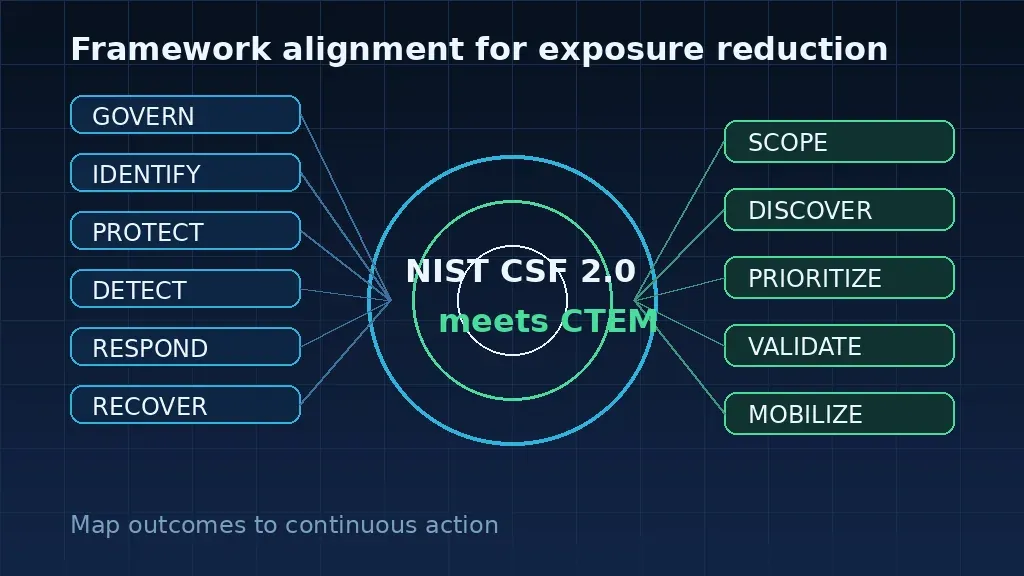
If ransomware is an economy, the rational defense is to attack its unit economics — make your organization more expensive to breach than the access is worth. That is precisely the problem Continuous Threat Exposure Management was designed for. CTEM reframes the question from "can we detect the attack?" to "does the exposure the attacker needs even exist — and would our controls actually stop the technique if it did?"
Here's where the market gets dishonest with itself. Nearly every vendor in security now claims a CTEM story. Most of them deliver stages one through three — inventory, aggregation, a risk score — and quietly outsource stage four, if they address it at all. But validation is the stage that breaks the RaaS business model, because it's the only stage that answers the affiliate's actual question: will the controls stop my technique? A prioritized list of 40,000 CVEs is a spreadsheet. An unvalidated control is a hypothesis. Ransomware affiliates do not negotiate with hypotheses.
"Assessment without validation is opinion. The attacker validates your environment every day. The only question is whether you validate it first."
Why Native Matters: The Uni5 Xposure Difference
This is the argument for a native CTEM platform — and it's the argument HivePro built Uni5 Xposure around. Uni5 Xposure was architected as a CTEM platform from the ground up, with Breach & Attack Simulation built natively into the platform, not bolted on through an acquisition or duct-taped in through a third-party integration. That distinction sounds like hair-splitting until you map it against the RaaS timeline.
Continuous, Not Bolted-On
When validation is native, it's continuous. The exposure that gets discovered is the exposure that gets tested — in one platform, one data model, one workflow. There's no swivel-chair between the tool that found the CVE and the tool that proves whether your controls stop its exploitation. Against an adversary whose disclosure-to-exploitation window is zero days, every integration seam between discovery and validation is dwell time you donated.
Prioritization Becomes Evidence
When validation is native, prioritization becomes evidence. Instead of ranking exposures by theoretical severity, Uni5 Xposure validates whether the exploit techniques tied to those exposures actually succeed against your deployed controls. The 40,000-CVE spreadsheet collapses into the set that is exposed, exploitable, and unstopped — which is the only set the affiliate cares about, and therefore the only set your remediation teams should be burning cycles on.
Assume Breach Becomes Measurable
When validation is native, "assume breach" becomes measurable. The entire post-EDR industry mantra has been to assume the attacker gets in. Fine — then prove what happens next. Simulate the credential abuse, lateral movement, and living-off-the-land tradecraft that now defines the ransomware playbook, and measure your control stack's actual performance against it — continuously, because the affiliate playbook updates continuously, and last quarter's purple-team engagement is already a historical document.
The Bottom Line
Detection tools answer "are we under attack?" — a question whose answer arrives too late by design. A native CTEM platform answers "are we attackable, and would our defenses actually hold?" — before the access broker lists you, before the affiliate buys in, before the negotiation portal loads. One of these questions disrupts the RaaS economy. The other one documents it.
Request a demonstration of HivePro Uni5 Xposure — and bring your hardest question about your control stack. We'd rather you ask it of us than have an affiliate answer it for you.
- Verizon 2026 Data Breach Investigations Report
- CrowdStrike Global Threat Report
- Coalition Cyber Claims Report
- Mandiant M-Trends
- ZeroFox Intelligence (IAB market analysis)
Figures paraphrased; consult original publications for full methodology.